Friday, September 24, 2021

Consent

Verbalizing the idea of a dog giving consent into an organized definition and conversation is relatively new to me.  There has been much recent discussion on dogs giving their consent, and that consent is a basic right of every sentient being. I feel like I've always had the idea of an animal giving its consent, with dogs but also with horses. It's practically impossible for a ~120-pound H. sapiens to get ~1,500-pound equine to do, well anything, without the equid first consenting to do the behavior. So the idea of an animal giving consent is familiar.

Our dog agility coach talked about consent in very simple terms, and I loved how she described it.  Basically, when using operant conditioning using positive reinforcement (often abbreviated as R+), when we give a cue for a behavior, the dog has a choice as to whether or not the dog wants to perform the behavior. She doesn't have to do the behavior. Nothing bad happens to the dog should she not do the behavior. However when the dog does choose to do the behavior, it learns that all sorts of good things happen as a consequence of doing the behavior.

We know behaviors followed by reinforcement will be strengthened, and be more likely to occur again in the future. It turns out that science supports positive reinforcement as the most efficient way to educate an animal.  It's great that the fastest, most reliable way to teach an animal is also the most fun and humane way, for both the learner and the teacher.

Rijkens consenting to carry me around

Pearls:

  • It seems natural to me to consider consent after working with Rijkens and other horses.  Good ol’ Rijkens was 1,500 pounds on a lean day, and happily consented to do many things
  • Take care when considering consent, if the dog chooses not to do the behavior for which the handler cues and is reinforced by something else for ignoring the handler, the likelihood of ignoring the cue again in the future increases 
  • The handler is best off setting up training scenarios that guarantee a 100% success rate, and the dog soon knows that all sorts of good things happen when they choose to follow the handler’s cues

Tuna Blondies

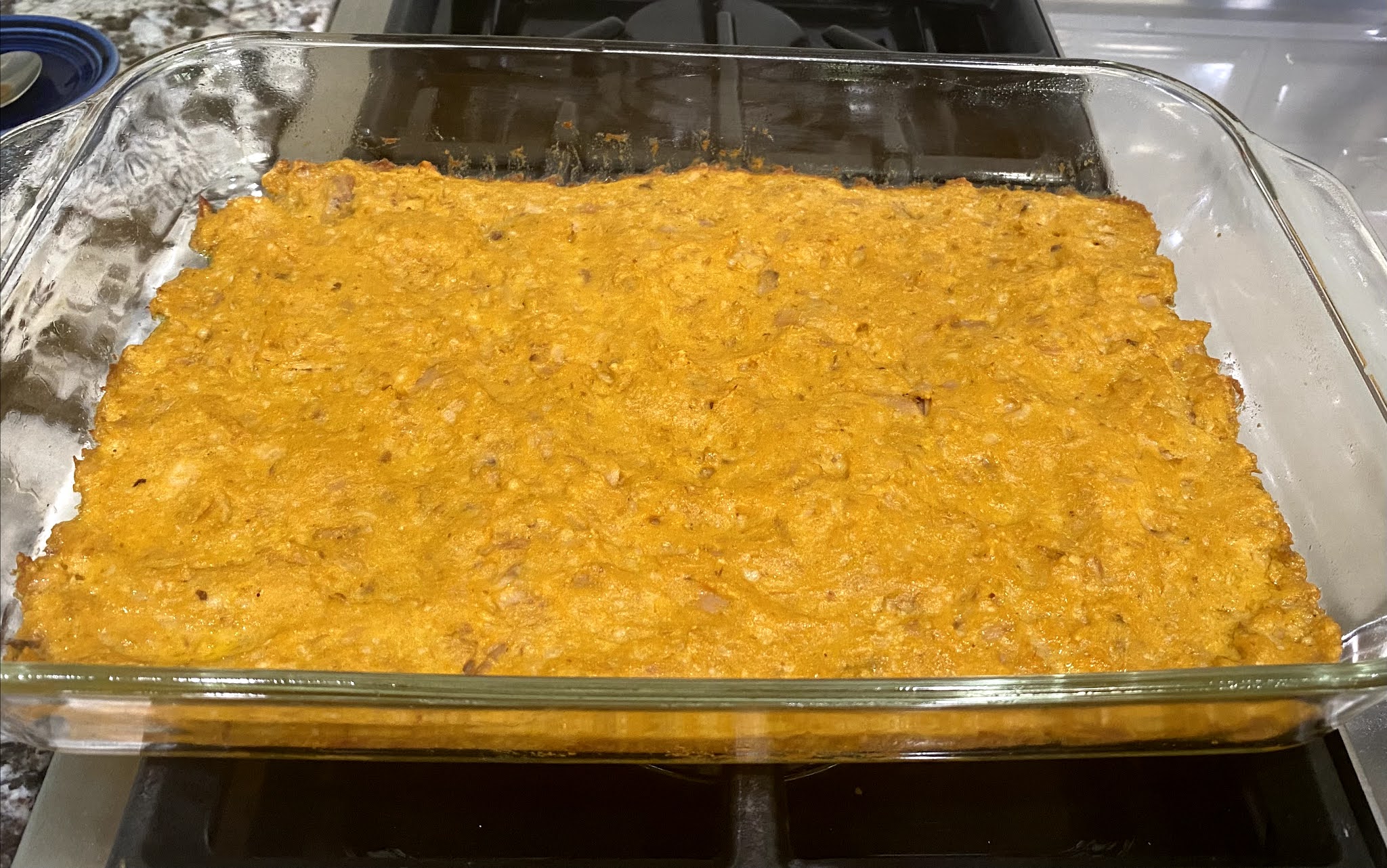
In the ongoing saga to find an irresistible reinforcer for Jackie, this week I tried a recipe shared by another dog trainer, my friend Marcella Ward of Dogs Speak Dog Training. Here's a link to her recipe. Marcella calls hers Tuna Fudge, but with the minor tweaks I made to the recipe mine were more like Tuna Blondies.

I started with best quality ingredients, and made a few modifications.  Since Gunner is on a heart-healthy diet, I used pink Himalayan garlic salt, and only used a very easy teaspoon. I quadrupled the freshly grated Parmigiano Reggiano cheese (I cheese from the heart), and the extra dry volume of the cheese enabled me to use only a tablespoon or so of flour, just enough to stabilize the mixture. I used a good heavy-handed 3 tablespoons of pumpkin to ward off any tummy issues.

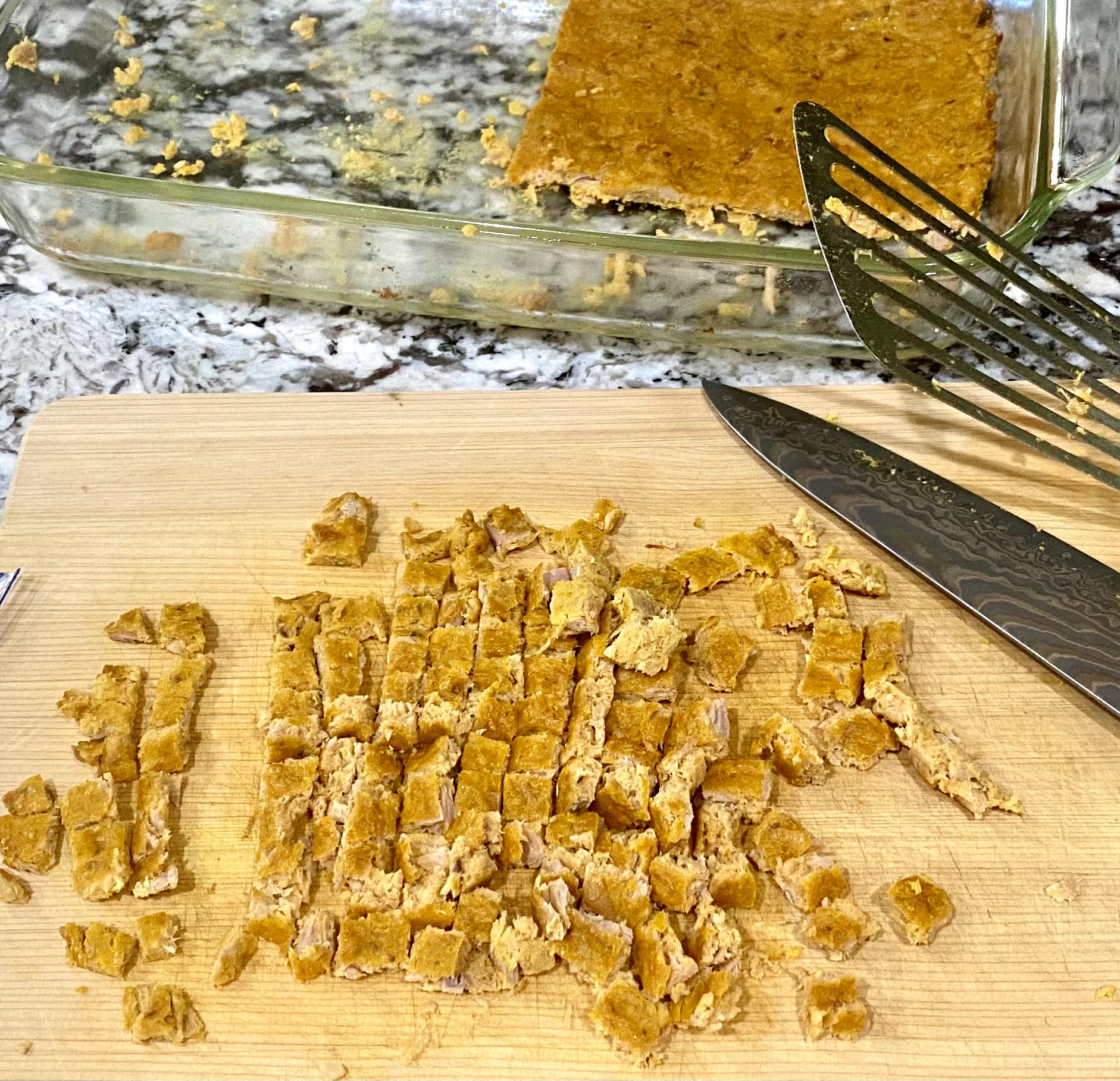
I very generously greased the pan with olive oil, which was good because the tuna blondies came out easily without sticking to the pan. The mixture spread very thinly in a 9" x 13" dish, which made it perfect for cutting into very small pencil eraser-sized cubes after it was baked.

Initial results are very favorable! Jackie even approached me while I was cutting up the Tuna Blondies to engage me with attention-seeking behavior, which is welcome. Between the Parmigiano Reggiano cheese and the tuna, this was a stinky (in a good way!) endeavor.  Gunner loves it too, and it is one of the highest value treats I've discovered for Jackie.

Starting with good ingredients:

Be sure to generously grease the pan, and don't worry how thinly it spreads, it didn't stick to the pan:

The extra pumpkin and the small amount of pink salt gave it a nice color:

The blondies lifted nicely from the pan with a spatula, and were thin enough to be cut into pencil eraser sized bites:

Jackie came 'round to investigate what the smell was:

Pearls:
  • Tuna Blondies are stinky and high-value for Jackie
  • Thank you Marcella of Dogs Speak Dog Training for sharing the Tuna Fudge recipe!
  • Tuna Blondies modified recipe is as follows:
Tuna Blondies
     2 five-ounce cans of tuna-- 1 in oil, 1 in water, drain the water and some of the oil
     2 eggs
     1 tsp garlic Himalayan pink salt
     4 Tbsp freshly grated Parmigiano Reggiano cheese
     Flour (enough for brownie consistency, about 1 Tbsp)
     3 Tbsp of pure canned pumpkin

Mix ingredients in a bowl.  Generously grease a 9" x 13" baking pan and spread the blondie mixture very thinly into the pan using a spoon or rubber spatula.  Bake for 20 minutes at 350 degrees F.  Allow the blondies to cool and cut into desired pieces.  Store in the fridge for up to 1 week and in the freezer up to 1 month. Pumpkin is added because these treats can be quite rich.


Raised by Wolves

Thanks to some very patient and long suffering dressage trainers, I’ve managed to learn one or two things about horses.  When it comes to formal training of dogs however, I’ve been figuratively (literally?) raised by wolves.  

After having about a 15 year break from formal dog training to immerse myself in dressage, I started my agility odyssey again with Gunner in earnest back in Houston several months ago. Quickly I realized during my first agility lessons that I didn’t really understand any of it, but that was ok, I embraced the journey of being a beginner.  Now that I am a couple weeks into starting Jackie, I am becoming very aware of how much I know that I don’t know.  

But reader, that is precisely what draws me to the formal training, and what makes it so exhilarating! I’ve used operant conditioning with positive reinforcement to teach multiple dogs many things, including AKC canine good citizen titles on several dogs, multiple AKC trick dog titles, and training and certification of a pet therapy dog for visiting nursing homes and rehabilitation hospitals; as well as using R+ successfully to train good all-around manners to many animals, including a rat, a bunny, and several horses.

Now that I’m seeking formal training again for myself while I train my dogs, it occurs to me I’ve been using an effective, though fairly disorganized, method.  I use my own body language, noises, and made up words.  Though it is organized and understood between my dogs and me, it is definitely a roughshod method compared to the formal classroom setting in which I am currently.  Learning to use a clicker as a marker versus using a word as a marker is so much harder than it seems it should be.  And I’m teaching myself a new release word too, adding to the juggle.

Today during a discussion about Clever Hans the counting horse it occurred to me that I probably often give involuntary cues via body language.  Which of course, everyone does, but it is interesting to me to see how much effort I am having to exert to teach Jackie simple cues like “sit,” “down,” and touch a hand target, that I’ve previously seemingly effortlessly taught other animals in the past.  

No matter, I will keep striving and learning.  And frankly, this is what makes it so interesting to persue positive reinforcement and learn ever more about the fascinating subject of animal cognition.  And if I ever get to run at an agility trial or perform in the obedience ring with a dog?  Well that’s just some awesome lagniappe!


Pearls:
  • Operant conditioning using R+ is so user friendly it is easy to be successful, even when one goes rogue
  • I know what I know (very little), and I know how very much I don’t know.  What I don’t know is what I don’t know that I don’t know.  But never mind, keep learning
  • Involuntary cues are just that, involuntary, and I’m trying to get control of my volunteers

Thursday, September 23, 2021

Basic Obedience Week Two

Jackie is continuing to do a great job in her basic classes this week, today we continued learning sit, down, and nose touch a hand target.  We also started short duration stay and learned a new release word, “break,” which will eventually become Jackie’s cue to start her agility course run. 

In transferring my previous release cue word which was “ok!” to a new release cue “break!” I learned today to say “break! ok!” and then I will gradually fade using the word “ok.” Also today while practicing short duration stays it was very apparent my timing with the clicker needs polishing, as I am still fumbling a bit with saying the cue, watching for the behavior, pressing the clicker, releasing with a new word first then the old word, then giving a treat. Whew!  Jackie is doing a great job in class. Me? Well I’m trying!

Our homework this week includes nose touch to the hand in different places with distance, the beginning of recall which is call their name and mark and treat them for looking at the handler, mark and treat for making eye contact and seeking eye contact, rewarding Jackie allowing me to grab her collar, spontaneously leaving food on the ground (also known as “it’s yer choice”) or what I think of as “hers whats” as in “hers whats ignores the cookie is hers whats gets the cookie,”and duration for sit and down stays.


Pearls:
  • After 30 years using “ok!” as my release word, switching to “break!” is proving to be harder than expected
  • To transfer an already learned cue from one word to a new word, you first say the new word followed immediately with the known word to get the behavior, then gradually fade the old word
  • Training a dog is easy; training a human takes real effort!  My timing and clicker management are a work in progress
  • Home work this week includes: nose touch in different places and adding distance, beginning whiplash turns (call Jackie’s name and mark and treat her for looking at me), mark and treat for making eye contact, reinforcing collar grab, hers whats, and duration for sit stays and down stays


Tuesday, September 21, 2021

Crate Games

Today in Foundations for Agility class at Cowtown Dog Sports we learned about crate games.  I’m late catching the bus on this one, but I’m so glad I’m on board now! Based on how quickly Jackie understood what was expected, I’m fairly sure her foster family must have practiced some version of crate games.

Our homework this week includes: putting Jackie in her crate, closing and latching the door.  Then I place my hand on the top of (or front of) the crate, which becomes a cue for her to sit (or lie down) and when Jackie sits or lies down I feed her a treat that I take from a bowl on top of the crate (rather than from a bait pouch on my body). Then I open the crate door; if she tries to exit the crate I simply block her calmly with the crate door, close it and start again.  Once she is sitting or lying down, I open the crate a tiny bit, Jackie stays laying or sitting, then I close and latch the door and feed her a treat from back in the crate (not near the door) as this builds value for being back in the crate.  

Eventually we gradually build up to opening the crate door completely and leaving it open while I stand back, while Jackie stays sitting or lying down, and Jackie remains quietly inside the crate until she is released with a cue. We also practiced Jackie staying calmly inside the crate while I put her leash on, and she only exits the crate when I release her with a release word “ok!” 

Playing the crate game builds value for Jackie being in her crate.  Going forward it is important to always be consistent when she is crated, to only allow her to exit the crate on her release word, and otherwise to build value for her to stay quietly inside the crate when asked, whether or not the door is open. 

It is ok for Jackie to decide to go inside her open crate on her own, and exit on her own. But when the handler places her in her crate on cue “kennel up!” Jackie stays in the crate quietly until released “ok!” whether or not the door is open or closed, and whether or not the handler is standing back, crouching, or holding her leash.

We continued with learning nose touch a hand target while in stand-stay.  The point is to reinforce Jackie for standing still in the same position. Our homework this week includes continuing to work on reinforcing stand-stay by having Jackie touch my hand target, then rotating my hand palm up and with my other hand dropping a treat into the now palm-up target hand and letting her eat it out of my flat upturned palm, and repeating several times while Jackie is stationary in a stand-stay.

When we were ready to leave class to go home, I was excited to see Jackie jump up into the back of the car into her crate!  Such a good girl, and it sure is a big help to not have to pick her up each time. In addition to being great for my back, this behavior is potentially life saving since it prevents her charging into traffic or loose into other dogs when exiting the car, or her crate at a dog show.


Jackie relaxing in her car crate, demonstrating the very useful and potentially life-saving crate game

Pearls:
  • Crate games, where have you been my whole life!
  • Foundations for Agility homework includes continuing to play crate games, and continuing to learn stand-stay
  • Jackie can self load into her crate, and knows to stay there until released, which is not only extremely convenient for me, but potentially life-saving


Monday, September 20, 2021

Clarity

Organizing my training this week around clarity, I have been throwing too much at Jackie too soon. I have such a huge desire to consistently do the right thing, teach with the best practices, and educate Jackie toward continuing to be a great companion as well as looking forward to an agility career, with the ability for a career in obedience should we choose. 

In order to be 100% consistent, it is impossible to teach all of this, all the time.  Starting Jackie in basic obedience class this week has helped bring some much needed clarity.  It seems obvious, but as an example I want to reinforce Jackie 100% of the time for coming to me, in order to teach a strong, reliable recall.  My observation was that if Jackie is interested in sniffing a snake, for example, and I call her off it to me, that praise and piece of reinforcing chicken in that particular moment is not reinforcing, but now rather I’ve punished Jackie for coming to me since she had to leave the much more interesting investigation of the snake.  

When I asked this question in class, I was given the permission to not get so much in my head.  Sometimes the handler cannot get into this negative loop of over-analyzing. One can bog down in the semantics and over-study of reinforcement theory, and miss the point.  And sometimes you just can’t allow the dog to do the thing, so recall her back and move on with your lives. Instead of trying to teach ALL THE THINGS RIGHT NOW, I’ve given myself permission to focus on just the basics to be learned this week: sit, down, and nose-touch-a-hand-target. 

Of course when the opportunity presents to reinforce other behavior I want, I will reinforce for that behavior when it is reasonable and clear to do so. Common sense goes a long way. However, for example Jackie knows to wait at the door before going outside, that should be enough.  I cannot dwell at the door, asking her to “sit” then reinforcing that, and then waiting for eye contact and reinforcing that, then reinforce releasing on an “ok” signal without me moving my body….. aaaaaahr! so Jackie is still at the door just wanting to go outside, which she does probably 100 times at day; it is a recipe for frustration! 

Instead, I need to pick one thing, she waits at the door then is allowed outside with a release word.  It is seemingly a small differentiation, but in the idea of making behaviors easy (for both handler and canine!) it is a BIG difference.  

Using the clicker more often has also been suggested to improve clarity, as much for me as well as for Jackie.  Using our marker word “yes” is fine too, but the clicker is a good skill for a handler to have, so I am making an effort to incorporate using the clicker in our weekly training.  

This week I’ve lessened my intensity in training, by focusing on only a couple three to five minute sessions a day, on the core elements from basic obedience class homework and basic foundations for agility class homework only. Slowing time down to speed up the training— a principle I learned  from dressage training during many years of ongoing clinic lessons with Jeff Moore, and a principle that I am still learning to apply with my dogs’ education as well.  

A dog, a person, a horse, can best learn only one specific skill at a time, so narrowing the behavior down to the lowest common denominator and consistently reinforcing that behavior will prevent frustration for the learner, and instill stronger skills in the long run. Eventually behavior will be stacked, but I need to avoid stacking behaviors when teaching.  I’m giving myself permission to choose A behavior, work on that for a few minutes a couple times a day, and otherwise give Jackie and myself time.

Pearls:

  • True clarity and consistency occurs by focusing on one small  individual behavior at a time
  • Studying theory is great, but leave it in your head while following best practices
  • Jeff Moore often talked about how to “slow time down” to speed training
  • Reinforce one simple behavior at a time; avoid stacking behaviors when training a new skill
  • Give yourself permission to go slowly; work few times a day for few minutes only 

    Jackie being beautiful 

Sunday, September 19, 2021

Border Collie Save Event

Today we got to meet some of the folks responsible for rescuing Jackie, at a fun event in Keller, Texas at Shannon Brewing Company at the Border Collie Save Brouhaha adoption event.  Jackie introduced us to her first foster mom and dad, who are the co-founders of Border Collie Save and Rescue. We were able to purchase some cool merch in support of the rescue, participate in a fund-raising raffle, and hear live local musicians as well as see a disc dog demonstration.  

We got to meet Kai, a little BC girl who was high on my list of potential candidates to adopt while we were still in the searching phase before we found Jackie.  Kai is as awesome as I imagined she would be, and while she may not make an international agility dog, she has the personality (and small size!) to make an awesome pet, and I’m sure she would excel at obedience, agility, and trick training, or anything else her person puts their mind to teaching.  At under 30 pounds she is the perfect size, and is the quintessential black-and-white easy-care coat that I love.

It was fun meeting other adopters and volunteers, and a bunch of great dogs. I am so grateful to the cadre of rescue volunteers out there, and especially to those at Border Collie Save and Rescue!

Kai:

As a Border Collie Save alumni, Jackie was given this sweet bandanna collar to show that rescued truly is the best! 

Pearls:
  • Grateful thanks to Border Collie Save and Rescue for their excellent work saving lives
  • It was very fulfilling to get to say a heartfelt  thank you in person to the people responsible for helping our sweet Jackie
  • Kai, and many other great Border collies are safe and well-loved, and ready to start their next chapter thanks to Border Collie Save and Rescue

Thursday, September 16, 2021

Time

Time is a fixed concept; we each have 24 hours in a day.  In my zeal to educate Jackie, it has been brought to my attention that I have to give her time.  Time for her to decompress, time for her true personality to emerge.  Time for her to learn how to dog.

In my defense I have been very patient, but patience can only go so far in a moment.  True patience has an element of passage of time, and there is (unfortunately) nothing we can do to slow time down, nor speed time up when we want it to suit our needs.  So in the passage of time, I have been encouraged to allow Jackie to do more sniff-walks, play with toys when and how she chooses, and smile and laugh with her often; and to limit our focused training to just a couple very short sessions throughout the day.

In Prissy’s final few weeks of life, we had some really awesome moments of closeness and affection. Because Prissy at that time wasn’t able to go for hikes or long walks, or run and play at the farm any longer, all that remained was time on the floor, on the sofa or bed, together, petting her and talking to her, just being with her.  To me that is the essence of a good relationship, that you can be together, happy and loving one another, even during “boring” moments of quiet time.

In the experimenting to discover what will be Jackie’s 100 dollar bill, it has become clear that one of Jackie’s favorite things is to be loved on and petted.  Jackie is very cuddly, and loves to lay next to her person. I’ll never know, but it seems Jackie may not have had much interaction with people in her life before she was brought into rescue, as she does seem to crave it now.  While she’s definitely not a velcro dog, Jackie certainly loves people and loves to be petted and groomed.  Similarly, she seems to relish being in a house, on a soft bed or sofa. She will very occasionally grab a toy and start to play with it by herself. In other words, she is  still “learning to dog.”

So this all takes time, and I am trying to keep my own agenda with her training in perspective.  Certainly with dressage the fastest way forward is often to slow down.  It has been said that it takes about three months for an adopted dog’s true personality to emerge; we have had Jackie now for six weeks; so….give it time. Above all I love her, and that is the most important item on the plan.

Pearls:

  • Patience is good, and includes an element of the passage of time
  • Lots of walks, sniffing, play and time to decompress is important for a newly adopted dog
  • It’s been said it takes at least three months, or more, for their true personality to begin to emerge
  • Even though I know I love Jackie very much, Jackie needs time to learn to be loved and feel love

Jackie learning how to dog


Wednesday, September 15, 2021

Theory Review for Agility Foundations

In reviewing dog agility theory, it has been iterated to me that a sport dog should maintain a lean physique, in order to avoid stress on organs and joints, and in order to avoid injury, as well as an ability to stay at peak output potential.  One wouldn’t expect, for example, to see a heavy marathon runner, so we should not expect our dogs to run well with extra weight either.  

It occurs to me this principle is best applied to myself as the handler as well, so while Jackie seems to have a body type (much like my previous Border collie Prissy did) that tends toward the lean-to-almost-skinny side, my own fitness level is best to be looked to as well, which I am actively working on by increasing exercise and being aware of diet choices. 

An exception to the lean rule is with a puppy; they don’t need to be rolly polly, but puppies should have a bit of extra weight because they are growing. In general, one should be able to feel an adult dog’s ribs, to feel their hip bones, and feel where their shoulder blades come together behind their withers.

Continuing the dog agility theory, the toe nails of agility dogs (really all dogs) should be kept short in order to maintain biomechanically correct movement as the dog runs, jumps, and moves over an agility course.  It is important to make a game of trimming their nails, with one snip and then a big fuss and a piece of cheese, another snip and another piece of cheese, and so forth. To get my dogs’ nail quick (the innervated vascularized core of the nail bed) to recede, I trim the nails very small amounts, frequently. 

Since Jackie is new, the first time I simply touched her paw while petting her and praised her generously then went on petting her.  The next time I saw if I could handle her paw during a petting session, which she consented to let me, and I praised her generously.  While grooming Jackie the first time, I held her paw then gave her a cookie. Then held her nail in my hand in the trim position (without the clippers), and gave her another cookie, and with her consenting I repeated that with all four paws and 18 nails, reinforcing for calm behavior.

The next grooming session, I brought out my guillotine clippers and held then to her paw (but didn’t clip) and gave her a cookie— repeat repeat repeat with reinforcement.  Then I progressed to trimming one nail, just barely into the nail, and reinforced her for lying still.  She was so chill about it all that I proceeded to trim all 18 nails, only just a little and with reinforcement for lying still. We had previously worked on reinforcing settling quietly so Jackie was already familiar. As a result, Jackie is now very willing about letting me trim her nails. (This is the same method I use with horses to teach them to stand quietly while I clip their ears, bridle path, and fetlocks, and pull their manes).

The other foundation that will help an agility dog is to allow her to walk over a myriad of different substrates, surfaces, textures, and elevations.  One can create this at home by laying items on the floor and walking the dog across and through them, and we can find many different surfaces while out hiking and walking in nature.  Not only is it fun, this also allows the dog to become aware of it’s own body while moving, a skill necessary to advance in agility. 

To teach the beginnings of making their contacts, the dog must learn a stand-stay.  The early phase of this for Jackie is, while standing she touches my hand with her nose when I hold it in front of her with my palm facing her, then I turn my palm up, drop a piece of food onto my upturned palm with my other hand, and let her eat the cookie.  Then I swivel my hand back facing Jackie while she’s still standing, when she touches my hand target with her nose I swivel my palm upward, drop another treat in my palm with my other hand, and let her eat it.  Then repeat, repeat repeat to build value for standing still. 

Pearls:

  • Maintaining a lean weight is important for agility
  • Nails should be kept trim, and over time with frequent trimmings the quick recedes
  • R+ can teach an animal to consent to almost anything (in college a saw chimpanzees that would voluntarily stick their arm through their cage for blood draws using R+ operant conditioning; I can closely shave even the inside of a horse’s ear while he stands sleepily after teaching this method)
  • Jackie is working on body awareness that will help her to navigate various surfaces and elevations, and stand-stay that will become correct contact behavior later

Jackie looking trim while being trimmed on the stainless grooming station

Dressage Lesson

Recently I’ve been riding Piper, a talented and patient off-the-track-Thoroughbred mare, in lessons with Lindsay Cooper at Kismet Sporthorses.  Today Piper and I did counter-canter loops for the first time which was great big fun.  In order to control my pelvis, it first starts with my shoulders.  By keeping my shoulders down and back, my elbows at my sides (think T. rex arms), and my torso tall, I can then influence my pelvis by moving with the horse.  Today we worked on my position, and bringing my inside shoulder back as I rise in rising trot, and by bringing my inside shoulder back as the horse’s withers come up (toward me) in canter.

In the counter canter loop, my inside shoulder came back-back-back-back in rhythm with the true lead canter, and in the counter canter phase my inside shoulder came forward-forward-forward while we were “bending” along the arc of the counter loop. This allowed my pelvis to follow Piper, and not to block her, so Piper was able to maintain her canter in balance.

With Piper, we want her to gain strength and build muscle, and while she is working on that we want her frame to be allowed to be a bit longer or “stretchier.”  But we ride with the idea that she is going toward carrying weight on her hind legs.  So even while she is stretching to the bit, we want to have the idea and the feeling that she is shifting her weight from her front end to her hindquarters.  Even when a horse is in very collected canter, for example in a canter pirouette, we want to know that in the contact we could stretch the horse toward the bit.  So we ride the greener horses this way, but with the idea that they begin to shift weight to the hindquarters.