Wednesday, February 11, 2009

Counter Canter on a Straight Line

Today Karen taught us a nice exercise for counter canter on a straight line. Begin from collected trot from the short side, for example on the right rein starting from C. Using the corner (between C and M in this example), begin a small amount of counter flexion left (bringing the shoulder in helps to insure the "correct" lead to get started) and ride straight ahead. Weight your left stirrup, counter flex left, and cue for left canter at B. Keeping the counter canter aids, at P make a twenty meter counter canter half circle to V, then ride straight ahead to make another twenty meter counter canter half circle at C. Again, ride straight ahead down the long side and make a transition to collected trot at B.
For the left rein, beginning from C ride straight down the long side, counter flex to the right and weight your right stirrup and at S cue for right canter, make a twenty meter counter canter half circle left from V to P, ride straight ahead down the long side, then another counter canter half circle left at C, then straight ahead and make a down trans to collected trot at S.

Saturday, February 7, 2009

Self Carriage

In working toward self carriage, the rider must remember to give the rein often, allowing the horse to carry herself for a few or several steps. The rider can take the rein firmly, even very firmly, but then must give with an allowing hand; never "hang" on the rein, particularly the inside rein. This giving of the rein not only works toward self carriage in the horse, it also has a calming effect on Delphi in that there is no resistance in the bridle for her to "fight" or fidget against, thus allowing her to be lighter in the hand, freer in the neck and shoulder, and working toward sitting in the hindquarter.
Yesterday, a very windy day, we were taking our lesson at the same time Teri was schooling a young jumper over fences and in the flying changes. Every time the youngster would get a bit fractious and a gust of wind would blow up her tail, Delphi felt the need to bolt. By riding with the hands raised to give the rein and sitting tall and upright (think "sit back") in the saddle, I was in an excellent position to control the forward momentum caused by the spook and bring Delphi immediately back to the exercise.

Friday, February 6, 2009

Woot! Woot!

Delphi and I are the 2009 recipients of the generous Houston Dressage Society Bushager Memorial Grant! Over the next several months I will work with my trainer Karen Brown in an intensely focused dressage immersion program, funded by this grant. I am so excited about the possibilities this award is bringing for Delphi and me! Our application essay is here.

My biggest champion and the best EVER groom, test caller, and trailer pilot Chris standing next to me as I receive the Bushager Memorial Grant at the HDS awards banquet:
This night one year ago he was sleeping next to me in a pink vinyl chair at the hospital. We've come a long way!
(See a related article in the HDS newsletter "Collective Remarks" page 13.)

Monday, February 2, 2009

Simplicity in Visual Aids

Volker's simple yet effective visual aids included my legal pad and ball point pen:
He "autographed" his notes with a hoofprint (must mean he's part horse).

Volker Brommann's lecture Saturday evening January 31 was basic, easy to follow, yet full of important pearls valuable to the training level youngster through to the grand prix campaigner.
Among other things, Volker covered the training scale:
Rhythm and Regularity (Takt)
Looseness/Relaxation (Losgelassenheit)
Contact (Anlehnung)
Impulsion (Schwung)
Straightness (Geraderichtung)
Collection (Versammlung)
Volker spent the most time covering the first three elements: rhythm, looseness/relaxation, and contact. These three together are considered the Familiarization Phase, and remain important throughout the horse's career. When the horse moves with rhythm and regularity, this metronome-like quality of the muscluature causes the looseness or relaxation of the horse, thus dis-allowing tension that could build from jerky or non-regular muscle movements. Only then can the horse reach toward the contact of the allowing hand of the rider.
Concerning "behind the vertical" Volker had this to say: according to the rule book it is never okay to ride the horse behind the vertical; however Volker stressed how important it is to never ride the horse behind the bridle. There are moments when the horse does come behind the vertical but it is still correct as long as the horse is reaching forward into the contact from a swinging back in self-carriage.
In working toward collection the horse must be asked to sit. However the horse should never be pushed beyond what its muscluature can endure. The horse should be developed in such a way as to allow the muscles of the horse to comfortably carry the horse on sitting quarters, with elavation of the entire horse rather than the false absolute elevation of the head and neck only, where the back drops and hollows and the quarters trail out behind (much as a dog does when scratching the dirt). Even within all three gaits, the horse should be allowed to stretch down and forward often to relieve muscle fatigue while gaining the necessary muscle that allows the horse to sit in true collection.
Concerning extended gaits, Volker answered that balance, harmony, and (again) regularity is more important than the oft seen "flicking" of the front feet but with the horse's hindlegs trailing behind (like the above dirt-scratching dog). Regularity with balance is even more important than overstride in the extended gaits.
Volker emphasized the responsibility judges have in rewarding and reinforcing the classical art of dressage (which is a many-years-long process that should progress slowly over time) versus rewarding and reinforcing the forced training of too young horses whose musculoskeletal system is not yet able to perform the demanding upper levels. As Volker pointed out, the rule book states that irregularity within a gait should at best be given a 5. Yet too often we've seen judges give 9's for gaits that, while impressive and impulsive in young horses, are still irregular. It is a major and ongoing debate (as is riding deep) that points to the responsibility of brave judges to reward correct and traditional training.
If we can manage to ride in such a way that we refrain from ruining or hurting our horses, and thereby allow us as riders to restore to them the balance, freedom and beauty that nature has already gifted them with in their riderless form, we will have done well by our horses.

(This article also published in the HDS newsletter "Collective Remarks" page 24.)

Monday, January 26, 2009

Building Confidence in Canter

During our most recent lesson with Karen Brown, Delphi and I learned two more excellent exercises to build Delphi's confidence (and mine!) in canter:

The first exercise begins on a twenty meter circle. Before A (or C ) on the short side make an upward transition to canter, from the walk or from the trot, it matters not. Say we've started this exercise in left canter, with the normal slight flexion left. When you reach the long side counter bend the horse to the right, then leg yield away from the long side to the left toward X, maintaining the left lead. At X change the bend again back to the "real" direction (in this case left) and make a ten meter left turn from the centerline to the long side, then ride straight ahead back toward your initial twenty meter circle.

The second exercise seems easier, and probably would be for most horses but Delphi found the first exercise easier than this one. Again you make an upward transition to the canter before the corner (we'll stay on our left lead again for the example). After the corner, turn down the centerline, stay in slight left flexion, and leg yield to the right from the centerline toward the long side. When you reach the long side make a ten meter left turn to the centerline. Delphi became a bit tense in the leg yield toward the long side; turning early at the quarterline in a near volte helped relax her by giving her something to do within all that arena space. Or, sometimes I would do the exercise from quarterline to quarterline, instead of going all the way to the wall.

Both exercises are helpful in building confidence, and the first especially works toward half pass at canter since you are basically doing canter half pass, but bent in the opposite direction to true "show mode" half pass.

Update: Delphi and I have been schooling these exercises the last three rides. Today we finally broke through the tension to some absolutely beautiful, soft, uphill leg yields in canter, using a full forty meters worth of arena without getting nervous or downhill. Progress!

Sunday, January 25, 2009

781 Ranch

Delphi's friend Charger entertained us this cold, blustery weekend at her new place west of Bellville, a beautiful 47 acre horse facility; truly a retreat. Delphi can't wait to visit in person.

A view of the house from the barn:


The barn and house:


The barn has a separate feed room and airconditioned tack room, and all six stalls have individual runs:


The turnout paddocks' gates:


Turnout paddock and another run-in shed:


Can you tell I like the barn?


Looking into Charger's stall from her run:


The folks of 781 Ranch will see you coming down their drive long before you reach the house:


Looking out the back door of the house:


Partial view of the hayfield (or riding trails!) brooding in the wintertime grey of cold; that sky on a clear, sunny day would be just as beautiful in a dissimilar way:


Speaking of riding, here's the ~100meter x 120meter arena, overlooking a beautiful yet tranquil hill:


More tranquility; overlooking the pond toward the old racehorse barn:


Charger's "mom" surveying her land:


Adding to the charm and serenity of 781 Ranch, a famous stallion is buried under a tree covered by a mass of tangled vines in a peaceful area down from the pond. The stallion was so beloved by his owners that it's written into the deed that any subsequent owners keep the gravesite and leave the marble stone to quietly remember their once great friend. *sniff* The stone reads
"Counterplay
TAAA
AQHA Champion
Superior Halter Horse
Here Lies a Great Champion
Mar. 25, 1963 - Oct. 8, 1978":


(See the article "One Foot in Paradise" in the HDS newsletter "Collective Remarks" page 7.)

Sunday, January 11, 2009

Saddle Trials: the Saddle Triumphant

And the winner is: the Albion SLK Ultima 18" seat wide tree:
a front view of the substantial knee blocks and cutback pommel:
Pros: The first saddle that, on first trial, does not pinch or otherwise put incorrect pressure on Delphi's withers, spine, or back! The gullet and channel are wide, with a cutback pommel that allows freedom of the shoulder and ample room for the withers. The large knee blocks and deep seat provide security. Extremely comfortable to sit, this is by far the most comfortable saddle evaluated. It left an even sweat mark revealing correct contact on Delphi's back.
Cons: it is a tad low in front, so has to be managed by putting a felt pad under the pommel to cause it to sit level on Delphi's back. (However, this extra padding could be removed later to allow for increase in muscle/weight over time so even this feature is potentially a pro depending on how one looks at it.)

Bottom line: the saddle fits with no rubbing or pinching, though it does have to be managed with padding to raise the front of the saddle (if only Delphi's front legs were an inch longer-- but alas!). My trainer Karen Brown has invented an ingenious padding system with a wool pad "insert" that goes under the pommel on each side of the back, but not over the withers or back. The wool is graded so that it gently feathers to a fine edge so the horse does not feel a rim or seam under the saddle. It raises the saddle in front so the saddle sits level. With the saddle's deep seat and those humongous knee rolls it is very secure and comfortable. Most importantly, it is comfortable for Delphi. Lovely!

The padding system Karen Brown created. Near side view (note how nicely it raises the pommel, with no pressure to the withers or spine):
Off side view:
Off side profile:

Wednesday, January 7, 2009

Delphi's Next Door Neighbor Poder

Delphi and her next door neighbor (heh- "neigh"bor) Poder (pronounced "Potter"):
Poder: gentlemanly and mild-mannered as always; Delphi: keen and interested in her surroundings as always. Some things are sooo predictable.

Sunday, December 28, 2008

Saddle Trials, Weeks Two through Five

As a round, plump, muscular horse yet with prominent withers, Delphi is proving challenging to fit.

My barn buddy Angela's 17 1/2" 31cm tree Courbette dressage saddle:
Pros: it fit me well and was comfortable to sit.
Cons: when astride it pinched Delphi's withers.
Bottom line: it didn't fit Delphi.

The next item on order to test ride is the Jaguar by Harry Dabbs 17 1/2" seat wide tree XKC deep seat dressage saddle: Pros: deep seat, relatively large knee blocks and buffalo leather provide security; wool flocked panels that sit away from the horse's spine since the saddle is wider through the gullet; higher, wider pommel to accommodate the withers
Cons: unknown commodity English-made saddle so am wary of the quality; if horse changes shape saddle can't be adjusted due to no interchangeable gullet system
Bottom line: the wide channel cleared her spine well, however when seated in the saddle the flocking under the pommel pressed into the muscling on either side of her back causing pressure to her spine behind the withers. It's possible that some of the flocking could be removed from the panel to adjust fit, but I dislike the idea of digging into a brand new saddle that does not fit from the outset.

Sunday, December 21, 2008

Saddle Trials, Week One

The process of choosing, fitting, and finally purchasing a new saddle is proving to be a great learning experience.

Fitting a saddle to the horse:
Place the saddle on the horse's clean back, two fingers width back from the shoulder, without a pad and without girthing the saddle.
*If the saddle is high in front, it is narrow
*If the saddle is low in front, it is wide
*If the saddle is level, it could be the right fit

Generally speaking, it is better to be slightly wide than slightly narrow. A narrow saddle can potentially hurt (or injure) the horse, while a slightly wide saddle can be used with extra padding (such as a sheepskin pad) to fit properly, and also allows for future widening due to growth or gaining muscle. Placing your hand under the saddle's pommel then "wiggling" the saddle (either from the ground or even more telling while mounted) allows you to feel any pressure points on the withers or spiny processes of the horse's back. The channel along the horse's back should be wide enough to allow a small fist between the rear gullet; this displaces the right amount of weight over the horse's back, rather than against the spine. Widening the gullet will cause the saddle to sit slightly lower on the horse's back, therefore the horse fills out your legs so you may want to lengthen your stirrup leathers a hole, and the same girth will fit a hole or two shorter.

The Wintec 500 Dressage saddle with Cair panels and interchangeable gullet, the saddle I currently own (size 18", wide tree):
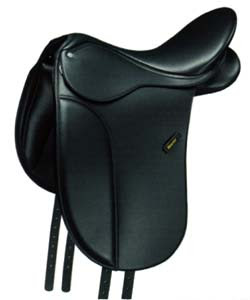
Pros: As far as fit goes I like this saddle just fine, I recently exchanged the medium for the wide gullet to allow for Delphi's growth and muscle gain, and the Cair panels do a good job of distributing the weight over Delphi's back.
Cons: It's plastic! After three years of use the billets are cracking and need to be replaced.
Bottom line: while the saddle is functional and fits fine I prefer a quality, leather saddle.

The saddles I will be evaluating this week include
the Stubben Maestoso, size 17.5", wide tree:
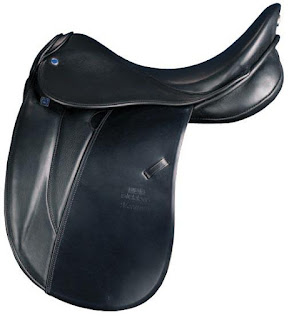
Pros: Stubben's craftsmanship, quality vegetable tanned comfortable leather, smaller knee blocks for freedom of movement, traditional wool flocked panels, optional larger knee blocks and optional Biomex spine relieving seat.
Cons: Biomex seat is new and unproven, even the larger knee blocks aren't as large and therefore as secure as some other saddle models.
Bottom line: while the 32cm tree fit her withers properly, the too-narrow channel put pressure points along Delphi's spine therefor not fitting her.

The Bates Innova with Cair panels, interchangeable gullet, and extended blocks, size 2, wide tree:
Pros: largest available knee blocks seem to provide extra security and maintain correct rider position, interchangable gullet allows you to change tree size as your horse changes shape or if you ride multiple horses, Cair panel can also have traditional wool flocking added if desired, wide channel to distribute weight evenly over horse's back.
Cons: giant knee blocks look funny and seem like "cheating" on your seat since they hold you into the so-called "correct Dressage position," suede on knee blocks will eventually become smooth over time and will have to be managed when it gets wet, sizing is 0, 1, and 2, with 1 being 17" to 17.5" and 2 being 18" to 18.5" so 1 is a hair small and 2 is a hair too big for my body (a 5' 8" 125 lb pear shaped female).
Bottom line: even with the wide gullet it sat too high on her withers and put pressure where it doesn't belong, yet with the pommel still being a tad low.

Stay tuned to see what Delphi has to say concerning the trial saddles. Already she's happy that I've correctly fitted her ever-widening and muscle-gaining body with a wide tree from the medium that came with her current saddle; her withers and shoulders felt better immediately and she is less tense after only two rides with the wider gullet.