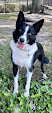
Contribute to the universe's knowledge of the human dog interaction by participating in Columbia University's research project. It says it takes 30 minutes but it took me much less. You don't have to be a dog-rotic like me to participate; you don't even necessarily have to own a dog!
Go to http://www.columbia.edu/~msw2111/online.html to take the survey.
Thursday, November 18, 2010

Assistant Dressage Coach
And guardian of the mounting block!
 Photo and captioning courtesy of Marlene. Unbearable cuteness courtesy of Nefyn.
Wednesday, November 17, 2010
Alphabet Soup with Stars
Delphi and I want to compete at the HDS upcoming CDI* Y/J show April 29-30 2011. Just so we're clear, here's a breakdown:
CDI is an acronym for Concours Dressage International, a dressage competition recognized by the FEI.
"W" suffix means world-cup qualifier.
"O" suffix means Olympic qualifier.
CDI*:
-INVITATIONS: No restrictions.
-LEVEL OF TESTS: Up to Intermediate I
-JUDGES REQUIREMENTS: At least three Judges (two FEI Judges)(one national allowed, one Foreign Judge optional)
-SPECIFIC REQUIREMENTS: Competitors living abroad may compete in events of their host country, with a license of their host country. Competitors competing in a foreign country require an official FEI passport for their horse. If competing in their own country, this is not required. NF approves schedules. GR Art. 154 (only Appeal President, i.e. active or retired FEI International Dressage Judge, required).
CDI**:
-INVITATIONS: No restrictions
-LEVEL OF TESTS: Up to GP, excluding GPS + GP Freestyle
-JUDGES REQUIRED: At least three Judges (two FEI Judges), at least one Foreign, one national allowed (Art. 437 applies)
-SPECIFIC REQUIREMENTS: See conditions above for CDI*
CDI*** (including CDI-W):
-INVITATIONS: At least six countries with min. two riders each must be invited (An OC may never invite more home than foreign riders)
-LEVEL OF TESTS: Up to GP, including GPS and GP Freestyle
-JUDGES REQUIRED: Europe: five FEI Judges, at least two Foreign, recommended three; Other countries: See Art. 437 CDI-Ws: three foreign judges required
-SPECIFIC REQUIREMENTS: Competitors may only participate under the jurisdiction of the country from which they hold their passport. Official FEI passport required for horses whether competing in CDIs*** at home or in a foreign country. FEI approves schedules GR Art. 154 (only Appeal President, i.e. active or retired FEI International Dressage Judge, is required).
CDI-Y/J:
-INVITATIONS: No restrictions
-LEVEL OF TESTS: Young Riders and Juniors Official Dressage Tests
-JUDGES REQUIRED: Judges: at least three FEI judges; one must be foreign. At Championships, five FEI judges; three must be foreign.
-SPECIFIC REQUIREMENTS: Competitors may only participate under the jurisdiction of the country from which they hold their passport FEI horse passport not required if competing in their home country (see Senior CDI**). Nevertheless, horses should be required to have a proper identification document, including FEI-type diagram and the required vaccination certificate. Only one Appeal President (active or retired judge) required.
CDIO**/*** and Championships: According to existing Rules
CDI is an acronym for Concours Dressage International, a dressage competition recognized by the FEI.
"W" suffix means world-cup qualifier.
"O" suffix means Olympic qualifier.
CDI*:
-INVITATIONS: No restrictions.
-LEVEL OF TESTS: Up to Intermediate I
-JUDGES REQUIREMENTS: At least three Judges (two FEI Judges)(one national allowed, one Foreign Judge optional)
-SPECIFIC REQUIREMENTS: Competitors living abroad may compete in events of their host country, with a license of their host country. Competitors competing in a foreign country require an official FEI passport for their horse. If competing in their own country, this is not required. NF approves schedules. GR Art. 154 (only Appeal President, i.e. active or retired FEI International Dressage Judge, required).
CDI**:
-INVITATIONS: No restrictions
-LEVEL OF TESTS: Up to GP, excluding GPS + GP Freestyle
-JUDGES REQUIRED: At least three Judges (two FEI Judges), at least one Foreign, one national allowed (Art. 437 applies)
-SPECIFIC REQUIREMENTS: See conditions above for CDI*
CDI*** (including CDI-W):
-INVITATIONS: At least six countries with min. two riders each must be invited (An OC may never invite more home than foreign riders)
-LEVEL OF TESTS: Up to GP, including GPS and GP Freestyle
-JUDGES REQUIRED: Europe: five FEI Judges, at least two Foreign, recommended three; Other countries: See Art. 437 CDI-Ws: three foreign judges required
-SPECIFIC REQUIREMENTS: Competitors may only participate under the jurisdiction of the country from which they hold their passport. Official FEI passport required for horses whether competing in CDIs*** at home or in a foreign country. FEI approves schedules GR Art. 154 (only Appeal President, i.e. active or retired FEI International Dressage Judge, is required).
CDI-Y/J:
-INVITATIONS: No restrictions
-LEVEL OF TESTS: Young Riders and Juniors Official Dressage Tests
-JUDGES REQUIRED: Judges: at least three FEI judges; one must be foreign. At Championships, five FEI judges; three must be foreign.
-SPECIFIC REQUIREMENTS: Competitors may only participate under the jurisdiction of the country from which they hold their passport FEI horse passport not required if competing in their home country (see Senior CDI**). Nevertheless, horses should be required to have a proper identification document, including FEI-type diagram and the required vaccination certificate. Only one Appeal President (active or retired judge) required.
CDIO**/*** and Championships: According to existing Rules
Lift, Lighten, and GIVE
In our lesson this week, we re-visited the all important give. Each time the rider does a half halt, or raises the horse's neck Jeff Moore style, or makes corrective or purposeful flexions and counter-flexions, one most follow up with a GIVE.
Let me define what Give means by first defining what it is NOT: 1) a give is NOT an offer to stretch (aka the stretchy down circle) where you keep an "elastic contact" with the rein. 2) A give is also NOT a mauling hang on the rein, with your hands "relaxed" but still pounds of weight on the rein.
Let me now define what a Give IS: at this point in Delphi's training, 1) a give IS at least 3 or 4 heartbeats long. This allows her to find self carriage; if she falls apart, drops to the forehand, raises her snout, or any other mistake-- OH WELL. She must still be given the chance to FIND SELF CARRIAGE which is why we have the GIVE in the first place! 2) A give IS a complete loop in the rein. This can be the outside, inside, or even both reins at the same time during certain movements to allow Delphi to lower her neck (think relax- the neck is still arched in a perfect world). Before the give, a half halt or lift should be accompanied by leg aids. One can always activate the inside hind or even reinforce the leg aid with the whip if needed.
We also schooled turns on the haunches at walk. Start the maneuver with a nicely marching walk, then begin by cuing for haunches in as though you were starting half pass in walk. When I feel Delphi's hindquarter stepping over and crossing, I then turn my body and look where I want her to go to allow her to turn around a small but marching walk circle with her outside hind leg crossing over and coming around the inside marching hind leg to describe the small circle. DO NOT dwell (that's a nice word for HANG) on the outside nor inside rein. If the outside rein is too firm (mauled upon) it will stop the outside hind from stepping around. If the inside rein is too firm you risk bending the neck too much to the inside (at best) or the horse just stepping out or the shoulder falling out. Rather than the reins, use your body to cue the turn around the haunch, which Delphi does quite nicely when you start from the established haunches in/half pass cue.
Moral of the story: it is the longer moments of harmony with the horse and lightness of the aids, especially lightness in the forehand, that I must now continually seek and reinforce as Delphi continues to improve in self carriage.
Let me define what Give means by first defining what it is NOT: 1) a give is NOT an offer to stretch (aka the stretchy down circle) where you keep an "elastic contact" with the rein. 2) A give is also NOT a mauling hang on the rein, with your hands "relaxed" but still pounds of weight on the rein.
Let me now define what a Give IS: at this point in Delphi's training, 1) a give IS at least 3 or 4 heartbeats long. This allows her to find self carriage; if she falls apart, drops to the forehand, raises her snout, or any other mistake-- OH WELL. She must still be given the chance to FIND SELF CARRIAGE which is why we have the GIVE in the first place! 2) A give IS a complete loop in the rein. This can be the outside, inside, or even both reins at the same time during certain movements to allow Delphi to lower her neck (think relax- the neck is still arched in a perfect world). Before the give, a half halt or lift should be accompanied by leg aids. One can always activate the inside hind or even reinforce the leg aid with the whip if needed.
We also schooled turns on the haunches at walk. Start the maneuver with a nicely marching walk, then begin by cuing for haunches in as though you were starting half pass in walk. When I feel Delphi's hindquarter stepping over and crossing, I then turn my body and look where I want her to go to allow her to turn around a small but marching walk circle with her outside hind leg crossing over and coming around the inside marching hind leg to describe the small circle. DO NOT dwell (that's a nice word for HANG) on the outside nor inside rein. If the outside rein is too firm (mauled upon) it will stop the outside hind from stepping around. If the inside rein is too firm you risk bending the neck too much to the inside (at best) or the horse just stepping out or the shoulder falling out. Rather than the reins, use your body to cue the turn around the haunch, which Delphi does quite nicely when you start from the established haunches in/half pass cue.
Moral of the story: it is the longer moments of harmony with the horse and lightness of the aids, especially lightness in the forehand, that I must now continually seek and reinforce as Delphi continues to improve in self carriage.
Sunday, October 24, 2010
Delphi made the ATA Homepage!
Heh heh heh. Princess toes was cited on the "News From the Show Circuits" American Trakehner Association web page for her test under dressage judge General Burton at Windy Knoll Farm.
Check out the link by clicking here.
Check out the link by clicking here.
The Trakehner Totilas sold to Paul Schockemohle
The Web site of the Trakehner Verband reports (October 15, 2010) that the dressage WEG triple-Gold Medal winner TOTILAS (by Gribaldi, out of a Dutch mare) has been sold to Paul Schockemöhle, former German Olympic jumper rider and top horse breeder and dealer, for an undisclosed price that is rumored to be in the double digit million Euro range. It is not clear whether Schockemöhle intends to compete the stallion or use him strictly for breeding.
Schockemöhle had also acquired Totilas' sire Gribaldi earlier this year but lost him when the stallion died unexpectedly due to a torn artery.
Schockemöhle had also acquired Totilas' sire Gribaldi earlier this year but lost him when the stallion died unexpectedly due to a torn artery.
Wednesday, October 20, 2010
Jeff Moore Clinic October 16-18 2010
Doesn't matter if she gazes at the sheep:
 Jeff raises Delphi's neck:
 There were uphill moments:
 Delphi raises her back:
 Round AND uphill:

Jeff had this to say about Delphi:
Concerning raising the neck and keeping the horse light in the hands, we learned the following from Jeff Moore:
You can raise the neck with the reins in light fluffs or when necessary when the horse crashes down loading the hands with weight, with a firm heave-ho up standing in the stirrups (always followed by the critical release with hands back down in normal position). You can get the horse tall and ugly (above the bit) with the neck raised up out of the horse's comfort zone to create experimentation. When the horse is working correctly, the bottom of the horse's neck becomes concave and the neck topline becomes convex. Raise the horse even higher than its version of above the bit until it decides on its own to drop its snout and yield to the bit.
She IS allowed to drop her snout down, but NOT allowed to load the hand with weight. I'm correcting her for the terrible down pressings, but I'm NOT trying to force her head down. I'm just saying "If I keep you in this kind of icky place, would you care to try an experiment or two?" And she says "Okay, how 'bout down crash-- it's my best trick!" Eventually there is a tiny glimmer of putting the nose down without putting pounds and pounds into my hand.
I want her to raise her back up and find my butt, so I keep a slightly lighter seat to encourage her back to come up. When the nose drops, it should be just as light in my hand as when the neck is fluffed up in the air. She has to be easily raisable any time whether she stays on the bit or not, MUST stay light in the hand.
The way to get her to experiment: first tell her the down smashing is NOT okay, then she floats around unsure of anything, then I raise her above her comfort zone even if it's above the bit and ugly. It is LIGHT, and ALIGNED, and higher than she'd like to be. Then I wait for her to experiment: she'll get tired of this and bored with this and start to press down and I'll say "NOPE, that's not an experiment I can accept." By keeping her higher than her comfort zone she'll start to experiment in other ways that might make her life easier. If I allow her to go around with a low neck, she'll be perfectly comfortable for 20 years!
So keep her higher than her comfort zone and then experimenting is allowed but NOT down crashing. She can slowly learn that it's okay to lower the snout but not to load the hand, and NOT to lower the chest and back. Then bit by bit we come to an understanding when she figures out how to stay round without getting heavy. I'll stop keeping my hands high and put my hands back down to normal.
For Delphi, at the moment, turning only on a polygon (with straight lines after each turn) and counter-flexion will help keep her straighter and keep her shoulder from falling out in the so-called "bend" of the neck. Don't necessarily think "bend" rather think "straight."
On the lengthening on the diagonal, at X do a soft, lifty, puffy bringing the neck up and back up with a tall fluffy rein back so the horse anticipates the lengthening as a preparation for a fluffy up rein back. Also do a fluffly rein back at the end of the lengthening.
Try dainty fluffy lifts up first; if the horse crashes down you can stand in the stirrups and heave the horse up. It is okay if the horse tosses her head up. Keep the horse way up high and dainty until the horse decides on its own to drop its snout.
The horse can lower its neck as long as it is not leveraging down into the hand. You teach the horse when you flutter the reins and raise the horse the horse collects under you. The complexis muscles should be seen in front of the middle and widest part of the neck; be seen the entire length of the neck; and be vibrant and alive.
Wednesday, October 13, 2010
Sunday, October 10, 2010
Day 1 Cimetidine Treatment

 Day 1 of Delphi being on cimetidine for the treatment of this benign tumor under her chin.
 The treatment regimen is five 800mg capsules twice daily for ten days, then five 800mg capsules daily for two months. I crush the tablets with a mortar and pestle and top dress her feed.
Time will tell if the cimetidine shrinks the melanoma.
Tuesday, October 5, 2010
Trakehners at the 2010 WEG
The following full and half-Trakehners competed in the 2010 Alltech FEI World Equestrian Games in Kentucky:
Dressage:
EXQUIS NADINE by E.H. Partout, out of Charites (KWPN), rider Hans Peter Minderhoud, The Netherlands – 10th after Grand Prix, 22nd after Grand Prix Special
HALBGOTT, approved stallion by E.H. Partout, out of Hatari by E.H. Consul, rider Marco Bernal, Colombia – 63rd after Grand Prix
MOORLAND’S TOTILAS by E.H. Gribaldi, out of a Dutch mare by Glendale (KWPN), Rider Edward Gal, The Netherlands – Individual Gold, Team Gold, Individual Gold in Freestyle
PRINS 32, Russian Trakehner, rider Susan de Klein, Netherlands Antilles – 39th after Grand Prix
SEDUC by Induc - Go On Then xx, rider Anne Troensegaard, Denmark – 47th after Grand Prix
Eventing:
JAKATA by Abdullah *Pg*E*, rider Piggy French, Great Britain – 24th after dressage, 12th after cross-country, 16th final
OPPOSITION BUZZ by Fleetwater Opposition, out of Jungle Bee xx by Java Tiger xx, rider Nicola Wilson, Great Britain – 42nd after dressage, 20th after cross-country, 15th final
OSTLER by Juror xx, out of Ostka by Jaskier, rider Lukasz Kazmierczak, Poland – 52nd after dressage, 54th after cross-country, 49th final
So, this moves Kobra von C and Kougar von C right to the top of the potential husband list for Delphi. Not that I'm looking, of course...
Dressage:
EXQUIS NADINE by E.H. Partout, out of Charites (KWPN), rider Hans Peter Minderhoud, The Netherlands – 10th after Grand Prix, 22nd after Grand Prix Special
HALBGOTT, approved stallion by E.H. Partout, out of Hatari by E.H. Consul, rider Marco Bernal, Colombia – 63rd after Grand Prix
MOORLAND’S TOTILAS by E.H. Gribaldi, out of a Dutch mare by Glendale (KWPN), Rider Edward Gal, The Netherlands – Individual Gold, Team Gold, Individual Gold in Freestyle
PRINS 32, Russian Trakehner, rider Susan de Klein, Netherlands Antilles – 39th after Grand Prix
SEDUC by Induc - Go On Then xx, rider Anne Troensegaard, Denmark – 47th after Grand Prix
Eventing:
JAKATA by Abdullah *Pg*E*, rider Piggy French, Great Britain – 24th after dressage, 12th after cross-country, 16th final
OPPOSITION BUZZ by Fleetwater Opposition, out of Jungle Bee xx by Java Tiger xx, rider Nicola Wilson, Great Britain – 42nd after dressage, 20th after cross-country, 15th final
OSTLER by Juror xx, out of Ostka by Jaskier, rider Lukasz Kazmierczak, Poland – 52nd after dressage, 54th after cross-country, 49th final
So, this moves Kobra von C and Kougar von C right to the top of the potential husband list for Delphi. Not that I'm looking, of course...
Subscribe to:
Posts (Atom)