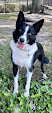
Today we continued jump training by playing jumps on a curved line. We also played serpentine jumpers to practice blind crosses for the first time, rear crosses, and front crosses.
Pearls:
When doing a blind cross, as you bring your new driving arm up, leave your arm out behind you and down a bit while wagging your hand to get your dog's attention onto your new cueing arm
Begin running with Jackie to get her running with me and ahead of me; play with rewarding on a small-ish circle for staying with me, and then rewarding for being on the inside of the circle or the outside of the circle I am describing for her to run
When doing front crosses or blind crosses, always turn toward your dog
Keep running! Dogs follow movement, and your dog will stop if you stop, so keep running
Playing jumping while turning tightly, blind cross, and front cross:
Jackie and I played two mini courses today: touch and go with hoops, and jumpers with a tunnel.
Pearls:
Agility is really just directing your dog along the line you want her to travel.
Keeping your arm down allows you to still direct her line without sending her too far out.
Allowing Jackie space will keep her true to her line and prevent overshooting the line she should follow.
Being confident as a handler in turn gives Jackie confidence. Give cues and directions assuredly, and Jackie will follow the line you're directing. Own it!
Of the five AKC novice rally courses to choose from for videoing, we chose Novice Course 1 (AKC RNV1) and recorded the course tonight.
Pearls:
Remember to use Gunner's event marker "Yes!" to let him know he has done the right behavior; Gunner is well conditioned to hold a behavior when he hears his marker word until the next cue is given
Continue to reinforce prompt, energetic heeling position
We recorded the AKC Rally Novice Course 5 tonight. Gunner has lots of enthusiasm and tries to add in extra tricks!
Pearls:
Grateful for how well Gunner is progressing and excited to be at the videotaping phase
Homework this week includes proofing sign 13 (Call Front – Finish Right – Forward – While heeling, the handler stops forward motion and
calls the dog to front. The handler may take several steps backward. The dog must come and sit in
front. Without the handler moving their feet, the dog must finish to the right. As the dog clears
the handler’s path, the handler will heel forward before the dog returns to heel position) and continue reinforcing brisk, prompt heel position
It takes three different videotaped Virtual Novice Courses (there are five novice courses from which to choose) scored by three different AKC judges with a score of 70% or higher to earn an AKC Rally Novice (RN) title
At the beginning of the video, the handler has to give a brief spiel saying the dog's name, his breed (be careful, since Gunner has his AKC Canine Partner number, he is considered by the AKC as an "All American Dog;" if you say "Border collie" or even "Mixed breed" the AKC deducts one percentage point from your final score!), you have to show that he is wearing a legal collar and leash, you have to remove the collar to show the camera and put the collar back on the dog, and you have to declare that you have no toys or treats on your person. At the end of the video you have to stand awkwardly and let the camera run for at least 5 additional seconds
Rally Novice Virtual Course 5:
Video clip (edited for brevity) of Gunner doing AKC Virtual Rally Novice Course 5:
Jackie and I met Sheelob today. Ok not really, but we did play with a very big spider. Much of canine jump training has emerged from what the experts have learned from teaching horses to jump, and today Jackie and I played with jump training.
The piece of equipment known as a spider helps the dog learn to jump with power from their hindquarters, as well as helping the dog use its own body most efficiently and comfortably for the dog. Using good ol' Sheelob, we cycled from 8 inches to 10, 12, 14, 16, all the way up to 18 inches, then cycled back down from 18 inches, 16, 14, 12, 10 back down to 8 inches, with the dog on both the handler's left and right sides.
In order to determine each dog's individual jump height, a series of five low (no higher than six inches) cavaletti are set in a straight line grid with a ground half pole set at the beginning. For both the spider and the cavaletti gymnastic, the point is for the dog to run straight through the gymnastic with his focus forward and downward toward a reward food bowl at the end of the gymnastic line. This teaches the dog to jump with their focus forward and downward, which is preferable to the dog jumping while looking up at the handler or around for sightseeing. The dog who jumps with their focus forward and downward is more likely to jump effectively, efficiently, and safely.
By visually assessing how the dog gallops through the jumping grid, as well as using a measuring tape placed alongside the jumping grid, it is possible to determine each dog's individual working stride length that is most comfortable for that dog. It turns out Jackie's working canter stride is five feet, a number we will remember for future reference while jump training.
Pearls:
The point is to allow the dog to jump freely, with their focus forward and downward, in the most comfortable and efficient stride over the jump
The handler stays stationary next to the reinforcement cookie, which is placed in and delivered from a food bowl or manner's minder so the dog's focus stays forward and downward
As well as the primary goal of teaching good jumping mechanics, jump training also builds tremendous intrinsic value for the jumps themselves
We played obstacle discrimination between tunnel and A-frame at the start line today.
Pearls when cueing tunnel versus A-frame from the startline:
Tunnel when it is furthest out from the handler: face your entire body perpendicular directly toward the dog's line with your cueing arm bent at the elbow, verbally cue "Break! Out! Tunnel!" while straitening your arm out in front of your body with your hand up in a stop sign position while stepping forward toward the dog's line into the tunnel
Straighten your arm out in front of you with your hand up while stepping forward toward the dog's line into the tunnel:
A-frame when it is closest to the handler: face your body and feet forward parallel to the dog's line; put your arm straight out from your shoulder, elbow locked; verbally cue "Break! In! Feet!" and when you say "In!" draw your straight arm in and down into your body along your hip to indicate the dog to come in toward you; then point your hand and arm to the A-frame indicating to the dog her line of travel "Feet!"
Handler's body and feet parallel to the dog's line with arm straight out from the shoulder is a clear visual signal that the dog will come to recognize:
Draw your arm straight in to your hip to indicate the dog to come in toward you:
Point to the dog's line of travel indicating the A-frame contact:
Be decisive and confident when cueing and directing your dog's line
We also played a mini-course of tunnelers.
Pearls:
When doing a front cross, always turn toward your dog
Cue tunnels early, while the dog is in the tunnel or often even before the dog enters the tunnel
When cueing tunnels, give the directional cue, for example "Go!" for straight ahead or "Here!" for a turn toward the handler, the obstacle itself in the line of the dog's path that you are directing becomes the cue to take each tunnel
Jackie learning Tunnel versus A-frame discrimination for the first time, and playing a tunnelers mini-course:
Upon encouragement from my coach, this week I started a twelve-week canine agility handler fitness program led by Liz Joyce called Fast and Agile. The goal is to improve my overall fitness level, as well as improve my running speed and personal agility.
THIS IS FOR JACKIE! and One foot in front of the next! are my phrases to repeat whenever I need to dig deep. The goal of this program is to increase my physical abilities as a handler, increase my fitness and be a better teammate for my dogs.
To document continued improvement here is a video of my first-week session, Fast and Agile Week 1:
When walking the course, first assess what order the obstacles are, then decide how you will play by considering your dog and your handling options. Sometimes a front cross works well, while other places a rear cross will work better.
Guide your dog's line as though you are pointing it out with a laser pointer, and support it with full body cues and verbal cues as needed. Mostly the dog runs based on the handler's body language.
Pearls:
Give Jackie space to run, allow her room at the jumps
Be a confident leader: believe in Jackie and allow her to run
When cueing contact behavior, be sure to get past the contact out front enough that Jackie can stop in 2o2o so she can see me while staying in the 2o2o contact position
Timing is important, cue early enough so that Jackie knows where she is going
Keep moving smoothly forward, indicating to Jackie where her line of travel will be