Monday, April 11, 2011
Delphi on the ATA Home Page
Click on "Delphinia and Chaffin win at Topsider Farm Dressage I" to see the News From the Show Circuits on the American Trakhener Association website.

Friday, April 8, 2011
Photo Shoot
Because we took absolutely NO pictures at our last show (Topsider Dressage I) today I braided Delphi, got her all cleaned up, and put on her show browband to take a couple photos for posterity's sake.


Wednesday, April 6, 2011
Long Lines
In-hand driving is an excellent way to develop balance and engagement; it encourages the horse to better connect from behind so the hind legs can step under to carry weight.
Karen taught us some basics in our lesson this week.

Just as in riding, I keep my elbows down and my core engaged:

Though we'd like to see her neck more relaxed, Delphi is engaged and becoming more uphill:

Delphi is relaxing into the work; I need to lower my elbows so my rein aids are more effective:

Uphill canter; engaged and in self carriage:

The uphill tendency is there; we would prefer Delphi's neck be more relaxed so she can better raise her withers:
 Inside (Delphi's right) hind leg stepping well under her body, with withers raised in relative elevation:

Photo credits: Karen Brown
Karen taught us some basics in our lesson this week.
We begin:

Just as in riding, I keep my elbows down and my core engaged:

Though we'd like to see her neck more relaxed, Delphi is engaged and becoming more uphill:

Delphi is relaxing into the work; I need to lower my elbows so my rein aids are more effective:

Uphill canter; engaged and in self carriage:

The uphill tendency is there; we would prefer Delphi's neck be more relaxed so she can better raise her withers:
 Inside (Delphi's right) hind leg stepping well under her body, with withers raised in relative elevation:
Photo credits: Karen Brown
Thursday, March 31, 2011
Cloning and Gene Banking
ViaGen, "The Cloning Company" can produce an exact genetic replica of my horse. Okay not MY horse, of course, but one's horse. Allie comes to mind: a 25 year old Hanoverian gelding with the patience and demeanor of a saint; Moorlands Totilas also comes to mind: how many horses earn in the 90th percentiles in Grand Prix dressage? (That would be a sum total of one: the Trakehner Totilas.)
So, for only $150,000 one can have an exact genetic clone produced of one's mare, stallion, or GELDING. Not sure if it's right for you now, or you just want to have a safety net to fall back on in case of accident or you geld a colt that later proves it could have been stallion material? For $1,500 you can gene bank your horse's DNA for storage for future cloning. But act now: only live tissue can be used so if your horse passes it's too late. Be aware: in my sport of Dressage there are no current restrictions about competing on clones; the Jockey Club flat refuses to register any clones and the AQHA racing industry is trying to fight the registration of clones for race track use.
Personally I see both sides: as a scientist it is definitely tampering with nature to throw out the possibility of desirable genetic mutations by making a heritable stamp of an existing animal (for example, Allie cribs: would his clone crib also?) and possibly stunting natural genetic progression for the improvement of modern horses. On the other hand, as an amateur horse owner, I certainly see the allure of reproducing an exact replica of a beloved animal that has proven itself in the barn aisle, competition arena, daily schooling, and maybe even the breeding shed.
Either way it is exciting to think about the possibilities of attaining the "perfect" horse, whether through the new hindsight of cloning or the traditional methods of humans trialing genetics over successive generations through selective breeding.
So, for only $150,000 one can have an exact genetic clone produced of one's mare, stallion, or GELDING. Not sure if it's right for you now, or you just want to have a safety net to fall back on in case of accident or you geld a colt that later proves it could have been stallion material? For $1,500 you can gene bank your horse's DNA for storage for future cloning. But act now: only live tissue can be used so if your horse passes it's too late. Be aware: in my sport of Dressage there are no current restrictions about competing on clones; the Jockey Club flat refuses to register any clones and the AQHA racing industry is trying to fight the registration of clones for race track use.
Personally I see both sides: as a scientist it is definitely tampering with nature to throw out the possibility of desirable genetic mutations by making a heritable stamp of an existing animal (for example, Allie cribs: would his clone crib also?) and possibly stunting natural genetic progression for the improvement of modern horses. On the other hand, as an amateur horse owner, I certainly see the allure of reproducing an exact replica of a beloved animal that has proven itself in the barn aisle, competition arena, daily schooling, and maybe even the breeding shed.
Either way it is exciting to think about the possibilities of attaining the "perfect" horse, whether through the new hindsight of cloning or the traditional methods of humans trialing genetics over successive generations through selective breeding.
Where Are They Now from Viagen on Vimeo.
Wednesday, March 30, 2011
Topsider Spring Show Stills


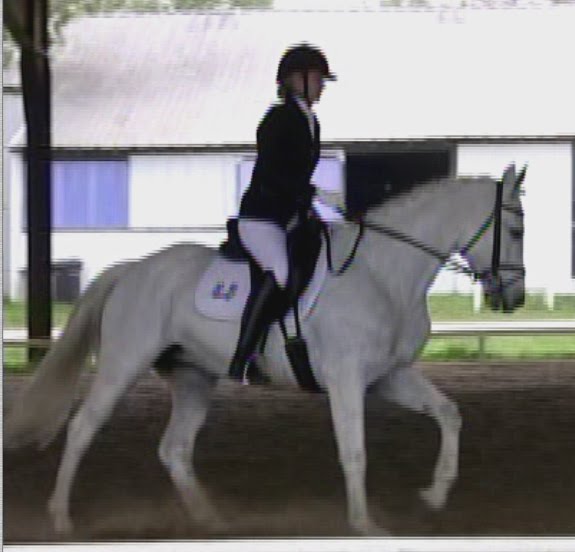


 Team Delphi bids a fond farewell to first level, and a warm hello to second and third level.
Monday, March 28, 2011
Topsider Dressage One Highlights
- For Karen in Second Level Test Three: "Nice pair- horse needs to better connect from behind so hind legs can step under and carry weight. Lateral movements need more suppleness and engagement."
- For me in Second Level Test One: "Attractive horse-" (At least she didn't say "Nice tail!") "Needs to improve uphill balance and engagement for improved collection and self carriage."
- For me in First Level Test One: "Attractive, willing horse. Try to develop more balance so horse isn't on forehand. Shows bend, but could have more energy at times."
Monday, March 21, 2011
Show Strategy
With our next recognized show less than a week away, show nerves have started creeping their way up my spine. Instead of trying to shrug them off or ignore them, I've decided to face them head on:
- Remember that I've stacked all the cards in my favor: while I may not ride the fanciest or most expensive horse, I ride a very nice mare that I love dearly and am proud to own. She has been consistently tutored by the best possible trainers, including Jeff Moore, Lurena Bell, and Karen Brown. Karen will be at the show to warm up Delphi and coach; I've done clinics when available; take a weekly lesson; Delphi is schooled and consistently ridden (wet saddle pad syndrome); I can honestly say I've done my due diligence.
- Rather than say "I'm not going to worry," I drew a bath, set a time limit, and said "Fine, go ahead and worry-- whatever your worst fears are-- dwell on them for this time period." After my time was up, I resolved to act on my chiefest fears, namely forgetting something important or leaving something undone or neglected. I made a list of everything to bring with me from house, grocery, and barn, and made a list of everything I must get done before the show date.
- Keep positively focused on our goal: we have every reason to expect that we will earn our final first level and initial second level scores toward our USDF bronze medal. And Delphi, piloted by Karen, is quite capable of qualifying for the second level open championship.
Wednesday, March 16, 2011
Dressage Frock
After a recent dinner party discussion about the creepiness of dis-embodied clothes hanging on the wall, I reluctantly post the following pictures of my new dressage frock that arrived in the mail today:


 It is a supposedly "breathable" polyester, it fits well, and I'm glad I ordered black rather than gray since when in bright sunlight the black tends toward a charcoal color.
Product: ELT Dressage Frock
Review: This coat has a velvet collar and silver piping on the collar and pocket flaps. It has a tailored cut and comes in European sizes so I ordered a size 38, which is a size larger than I would normally wear. I purchased it from Smart Pak for $95. It comes in three color choices: black, navy, or gray.
Pros: Very economically priced off-the-rack coat, easy care and wrinkle resistant polyester. With the contrast piping and velvet collar, it really is a pretty coat. The fabric will hopefully be cooler than wool.
Cons: If it had one or even two extra buttons I think it would fit even more nicely than with its three buttons. It's polyester, and not even the best synthetic will ever look as nice as real wool. It remains to be seen how many thousand white horse hairs that velvet collar will attract!
Bottom line: for the price it can't be beat and it seems to fit very well, though I ordered a size larger after reading reviews on the Smart Pak website. For value and low maintenance (it came folded several times in a small box and virtually had no wrinkles) I recommend it.


 It is a supposedly "breathable" polyester, it fits well, and I'm glad I ordered black rather than gray since when in bright sunlight the black tends toward a charcoal color.
Product: ELT Dressage Frock
Review: This coat has a velvet collar and silver piping on the collar and pocket flaps. It has a tailored cut and comes in European sizes so I ordered a size 38, which is a size larger than I would normally wear. I purchased it from Smart Pak for $95. It comes in three color choices: black, navy, or gray.
Pros: Very economically priced off-the-rack coat, easy care and wrinkle resistant polyester. With the contrast piping and velvet collar, it really is a pretty coat. The fabric will hopefully be cooler than wool.
Cons: If it had one or even two extra buttons I think it would fit even more nicely than with its three buttons. It's polyester, and not even the best synthetic will ever look as nice as real wool. It remains to be seen how many thousand white horse hairs that velvet collar will attract!
Bottom line: for the price it can't be beat and it seems to fit very well, though I ordered a size larger after reading reviews on the Smart Pak website. For value and low maintenance (it came folded several times in a small box and virtually had no wrinkles) I recommend it.
Friday, March 11, 2011
How to Tie a Stock Tie
After much thought about reaching deep down and becoming the dressage rider, channeling my inner Edward Gal etceteras etceteras, I've decided to graduate from wearing a pre-tied stock tie and the hunt coat from my college days of riding hunter jumper to an actual dressage frock and a real stock tie. Which means I must learn to tie a real stock tie.
After researching the matter, here's what I've learned:
Traditional formal attire for foxhunting where the rider wears the traditional hunting shadbelly is also where our modern dressage costume has its roots. The shadbelly of course is considered very formal riding attire and is reserved for the most formal situations for foxhunting members, upper level dressage riders, or eventers. Nevertheless it is good for one to know the tradition.
The stock tie for traditional formal attire for foxhunting, then, must be all white (no piping or other decoration) and the pin must be plain gold (crystals or other fancy decorations are not traditional apointment). The usefulness of the stock tie is that is creates warmth around the neck while hunting out in the cold, and can be used in an emergency as a pressure bandage or even a sling.
The minimum size to work well is 67 inches but 70 inches is best (I ordered a "medium" or 70 inches). To properly tie a stock tie:
Edward Gal and his elegant, if non-traditional, gray shadbelly (and his black Trakehner Moorlands Totilas):
 The dressage frock I ordered is available in charcoal gray. I agonized over whether to order the gray one as I thought it would both help me in channeling my inner Edward as well as flatter myself it would look dapper with my gray horse. Alas, I humbly ordered the black one (though I admit it has a black velvet collar and silver piping AND I plan to use my crystal-decorated moose antlers pin with my stock tie) and will reserve my days of non-traditional coat color for when I am riding at the Olympic level. Until then we continue to learn.
After researching the matter, here's what I've learned:
Traditional formal attire for foxhunting where the rider wears the traditional hunting shadbelly is also where our modern dressage costume has its roots. The shadbelly of course is considered very formal riding attire and is reserved for the most formal situations for foxhunting members, upper level dressage riders, or eventers. Nevertheless it is good for one to know the tradition.
The stock tie for traditional formal attire for foxhunting, then, must be all white (no piping or other decoration) and the pin must be plain gold (crystals or other fancy decorations are not traditional apointment). The usefulness of the stock tie is that is creates warmth around the neck while hunting out in the cold, and can be used in an emergency as a pressure bandage or even a sling.
The minimum size to work well is 67 inches but 70 inches is best (I ordered a "medium" or 70 inches). To properly tie a stock tie:
- Place the button hole of the stock tie onto the button on the front of your rat catcher shirt.
- Thread the end of the stock tie through the self loop or gap in the stock tie so that it lies flat around your neck. Put the stock tie as tight as is comfortable-- you don't want it to choke you but you want it fairly snug.
- Some stock ties have a longer side (some don't); if so start the square knot with the longer side on your right so the knot is tied right over left then left over right.
- Make a square knot by turning right over left like tying a pair of shoelaces; make it snug. Then tie left over right. You want the square knot to lie flat with a sleeve-like appearance. One side of the stock tie bite will be slightly shorter than the other.
- Take the extra bite end on each side (right side first) and flip it over toward your midline to create a little bit of puffiness, and create a V with the stock tie ends so the V is over the knot but the knot is visible between the V.
- Run your plain stock pin through both pieces that flap over and also run it through some of the threads of the knot so that it stays in place. Safety pin the bottom ends of the stock to your shirt so that it stays neatly tucked in.
Edward Gal and his elegant, if non-traditional, gray shadbelly (and his black Trakehner Moorlands Totilas):
 The dressage frock I ordered is available in charcoal gray. I agonized over whether to order the gray one as I thought it would both help me in channeling my inner Edward as well as flatter myself it would look dapper with my gray horse. Alas, I humbly ordered the black one (though I admit it has a black velvet collar and silver piping AND I plan to use my crystal-decorated moose antlers pin with my stock tie) and will reserve my days of non-traditional coat color for when I am riding at the Olympic level. Until then we continue to learn.
Subscribe to:
Posts (Atom)