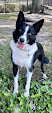
Jackie and I were introduced to barrels today. Foundations for running barrels include using both a body signal (wrapping your curled fist in a circular motion to indicate which way to run around the barrel) and a voice cue (neh neh neh neh neh neh neh neh-- like a motorcycle). Remember to wrap your fist like a gorilla beating its chest, in the same direction you want the dog to wrap the barrel. Have a treat in your other hand, the one not wrapping to indicate direction, and toss the treat on the floor in front of the dog in the direction you want her to keep going past the barrel.
Today we also played another mini-course and played the A frame contact again. Today was the third time Jackie has seen the A frame.
Pearls:
Remember to point your feet as well as body in the direction you want the dog to follow
After a successful stopped contact, you can release the dog with "Break!" or you can release the dog with a cue for the next directional cue "Here!" or obstacle cue "Go!" but be sure you are releasing them from the stopped 2o2o contact
Jackie playing a mini course; this is her third time playing the A frame:
Jackie is confidently offering high five and wave on cue. She has bow while still being lured, so we are working on putting her bow on cue, "Bravo!" Rollover is coming along nicely with a lure.
Tonight we learned peekaboo, where she walks through my legs and peeks up to look into my face while standing still between my legs. We also practiced on the wobble board, she is confident on in but still needs to get more fluent in handling it alone with her own body as I'm still helping her stabilize the board with my foot when she gets too shaky. Eventually she will need to show 3 seconds by herself on the wobble board (for a novice trick).
Pearls:
When teaching peekaboo, it is helpful to ask the dog to sit-stay, then position yourself in front and then cue the trick behavior
Following the DMWYD trick list is a helpful guide to inspire a progression of choosing which tricks to play next
Front crosses continue! Jackie and I practiced front crosses with the dog starting on my right and me crossing in front of Jackie to have her end up on my left. We practiced a series of obstacles incorporating a front cross: start line, bar jump, front cross to bar jump, hoop, and tunnel.
Pearls:
Stand up straight! Leaning over or stooping can push Jackie out away from me; instead, I need to stand tall and direct her path with clear arm and hand cues, supported by body position and voice cues as required
Turn toward your dog side hand when doing a front cross, and always reward with your dog side hand so the dog builds value for following your driving hand
Video clip showing front cross within a mini-course:
Gunner was recognized at the yearly Cowtown Dog Sports holiday party for the titles he earned this past year 2021, which were his AKC Trick Dog Novice, Trick Dog Intermediate, and Trick Dog Advanced titles. Robin also gifted me with a sheep of my very own, as she rightly pronounced that not only do I have Border collies, I am a Border collie. Yeah, accurate.
Pearls:
It is meaningful and affirming when people whose opinions matter mark your achievements
Our coach put much thought and effort into this yearly tradition, and it was inspiring to be among my peers as they were recognized for all of the impressive milestones they made with their dogs through this past year
I'm grateful to be among such a community, with the support of a coach that encourages both continued scholarship as well as building an even stronger relationship with our canine companions
Jackie and I added Tricks Class to our roster at Cowtown Dog Sports this week. Our coach Robin likes to use the Do More With Your Dog program for titling. Each team can join the Wags to Wishes Sparks Team moderated by Karen McClean who can approve your tricks via video posted to her facebook group to earn DMWYD titles.
As Robin pointed out, titles are a nice way to follow an outline of teaching tricks, and teaching tricks is great for building a strong relationship with your dog and increasing your dog's body awareness and fitness, and allows your bond with your dog to deepen. Plus, it's great big fun!
Jackie recently earned her Novice Trick Dog title through DMWYD, so our next step will be to earn her Intermediate Trick Dog title. The four trick dog title levels are Novice (15 novice tricks, 30 for Masters Novice), Intermediate (12 intermediate tricks, 20 for Masters Intermediate), Advanced (5 advanced tricks, 10 for Masters Advanced), and Expert (5 expert tricks, 10 for Masters Expert). Additionally you can earn Master's titles at each level, as well as several other titles like stunt dog titles and specialty titles.
The comprehensive DMWYD tricks list is a great resource complete with descriptions and videos from each title level, and is searchable. Our wishlist of intermediate tricks to learn next includes:
Shake hands
High five
Rollover
Selfie (where the dog poses with the handler for a photo)
2 on/2 off peanut
Balance on top of a ball or peanut
Barrel racing (go out and around a cone or object)
Baton jump (jump a handheld bar)
Directional casting (send to specifically 1 or several platforms)
Figure 8s through my legs
Hand signals (6 behaviors)
Jump through my circled arms
Jumping figure 8s (over bar jump)
Leg weave
Peekaboo (remain between my legs while I walk)
Platform jump with hoop between platforms
Sit pretty (the Lassie pose)
Soccer (push a ball)
Stay out of sight 20 seconds
Sustained nose touch (4 seconds)
Target mark (go to flat/low mark)
Emergency stop
Hoop jump over another dog's back
Jump wraps
Paw wrap around object
Tell me a secret
Advanced tricks we want to learn include:
Back up (5 feet)
Bow
Broad jump
Distance work (3 behaviors 10 feet away)
Double hoop circle (2 hoops at my sides, dog circles me)
Footsies (peekaboo, dog places paws on my feet)
Head down (chin rest)
Heel at left side, automatic sit
Hug (hug a pole with front arms)
Jump over my back
Play dead
Say your prayers
Side (swing to finish to sit at my left)
Sidestep drill (front feet on object, rotate around)
Spin a tight circle on a small pedestal
Tap light/desk bell/easy button
Teeter-totter
Wave bye
We haven't identified many expert tricks to gun for just yet, but on the list is "play chess." A Border collie should be able to do that, right?
Jackie earned her Novice Trick Dog title:
Pearls:
When teaching rollover, from a prone position, lure the dog all the way over to her other side, then have her stand up again then deliver the food treat
If you get "stuck" during teaching a particular trick, go back to something easy the dog already knows so she can get rewarded and stay motivated
When teaching bow, with the dog in standing position, stand directly in front of the dog and lure her with a cookie held upright in your hand and lure backward between her front legs; mark and treat even for just a dip of her elbows to begin
Jackie learned shake hands easily: by petting her and pausing, engaging her "puppy milk let down" instinct to press her paw forward to ask for more, then I simply capture that natural behavior and put it on the cue of offering my hand in handshake position; in my experience most dogs come with this trick even more pre-wired than sit or recall, and you can use shake to easily build into high five and wave
Jackie and I learned front crosses today, with much success. The handler's footwork matters, and it is a good idea to practice front crosses (as well as other footwork) without your dog so you can perfect it.
When teaching foundations for front crosses, the first few times reward them for coming to the "new" cueing hand. For example if the dog is starting on your left and you will front cross to have the dog on your right, have a cookie in your right hand and deliver the food reward as soon as the dog gets to your new driving hand, in this case your right hand.
We also practiced playing several obstacles in a series of turns. It is important to realize the handler is drawing the dog's path of travel with their hand and arm cues. You can think of it as using an imaginary laser pointer with your cues to show the dog its path of travel. Think of "don't spill your beer" in that before one driving hand goes down, in a front cross for example, the other driving hand comes up to take the "beer" so it doesn't spill, and the dog doesn't lose the correct path of travel.
Pearls:
A front cross is changing the handling side in front of your dog; front crosses are used in many situations in agility: the handler can use them on straight lines but also to cue tight directional turns, even turns as tight as 180 degrees
Footwork is important and it is helpful to practice without your dog to perfect your own footwork
The handler's cues are all just describing to the dog the path she is to take
Video clip of team Jackie's first front crosses, as well as slo-mo detailing front cross handler footwork and hand/arm movement:
Not quite a ballerina, but we're having fun anyway!
Jackie and I participated in the Cowtown Dog Sports Agility Contact Workshop Part 2 this weekend with much success. New skills learned included cueing directional turns off of a contact. We were also able to practice playing correct start lines and perfect 2o2o behavior.
It was a great educational experience getting to rehearse stopped contacts, and begin linking obstacles such as hoops, jumps as well as turns before and after the contacts.
Pearls:
To begin, teach straight directions off of contacts "Go!" and when that is solid teach turning toward the handler directional cues "Here!" and when that is solid teach turning away from the handler cues "Back!"
Be extremely diligent in reinforcing absolutely correct start lines and 2o2o behavior. If the dog blows past the end of the contact, it can be ok to circle the dog back around onto the contact and reinforce correct 2o2o, but only once or twice, otherwise the circling around can become part of the behavior which is not correct 2o2o behavior
To reinforce correct 2o2o behavior if the dog is struggling, it is best to return to the start and play the behavior again, capturing and jackpotting correct 2o2o contact behavior at the end of the contact
Vary the amount of time the handler waits to release the dog at the start line and after the contact, so the dog doesn't begin to anticipate the same rhythm each time
At the start line it is best to just say "Break!" and then the obstacle name "Feet!" (for the dog walk) and directionally point to the dog's path of travel. No need to say "Break! Go! Feet!" you can just say "Break! Feet!" and visually cue the dog walk by pointing straight ahead to the 2o2o contact zone
Remember to follow through by running past the final obstacle with your dog; pulling up or stopping short may cause the dog to stop and turn around to see what you're doing and possibly miss the final jump; rather keep going to indicate to your dog that she is to follow through over the final obstacle
Video clip of Jackie learning directional cues to and from contact, and practicing 2o2o stopped contacts:
Gunner and I played our longest mini course to date, and to start the night we did a practice run where I put away my bait pouch and used verbal praise without food rewards.
The new signs we practiced tonight for the first time included:
Moving Sidestep Right: Without hesitation and still heeling forward,
team takes one handler right diagonal step in heel position towards
sign.
Offset Serpentine Right: Three cones are set 6
- 8 feet apart for Novice
and Advanced; 4
-6 feet apart for Excellent and masters. The middle
cone is moved 3
- 4 feet to the right. The team enters with the first
cone on their right, and weaves through with the second offset cone
to their left and the final cone to their right. Entrance and exit for this
sign are straight on and do not create a turn for the entrance or exit.
45° Diagonal Left: Team makes a 45-degree turn to the left in heel
position.
Halt, Front Dog, Finish Left, Halt: Handler stops, dog sits in heel
position. Handler steps around to front of dog. Dog finishes back left
to handler to heel position, dog sits. Team heels forward moving in the
opposite direction they were traveling.
Gunner and I playing the mini course, we were experimenting for the first time without using food treats:
Gunner and I playing the mini-course using food rewards:
Pearls:
Homework includes reinforcing optimum heel position. While heeling, Gunner's shoulder should remain at my pant seam
Using a platform to improve and reinforce heel position is done by having Gunner on the platform, reinforcing for being in optimum heel position, then tossing a food treat away "Get it!" and then "Heel!" and reinforce when Gunner returns to optimum heel position on the platform
Using a high rate of reinforcement keeps up motivation and interest