Monday, April 6, 2009

Delphi's response to work

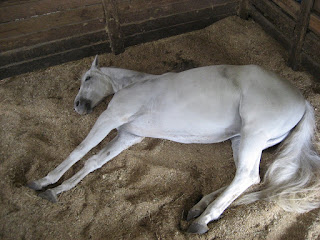
Delphi's trainer Karen Brown grabs her halter to get her for schooling this morning and finds this:

*A sleepy eye blinks open.* "Huh? You want me to do what?"

"Work? You must be joking."

*Groaning noises.* "I'll be up in a minute..."

*Bottomless snoring noises as she rolls deeper into the bedding.* "Zzzzzzz"

Photography courtesy of Karen Brown.

Wednesday, April 1, 2009

Lightness in Self Carriage

The theme for Delphi's and my Dressage immersion program seems to be developing into "self carriage." Today Karen said she wants to get me "addicted" to riding the horse in such a way that she is light, submissive, and in self carriage. I'm on my way to becoming a confirmed junky. Today again we worked on lifting the horse's neck, yielding (giving the rein), then lightening; this series of actions makes the horse's quarters jump underneath her body and the horse's poll is the highest point with a soft jaw. Ahhhh, lightness in self carriage. I need to work on giving the rein; I have to give the rein after every two seconds of firmness. I'm not allowed to dwell on one rein or the other, nor am I allowed to "saw" the rein-- rather make a deliberate correction with the rein to bend the horse, then yield, then correct as needed, then yield: repeat, repeat, repeat-- until the horse is light and in self carriage. In the up canter trans I must raise the neck, engage the hindquarter, and GIVE THE INSIDE REIN into the trans. Result: beautifully soft and uphill canter transes.

Wednesday, March 25, 2009

Self Carriage

The second level horse must have self carriage in order to progress. In working toward self carriage in our lesson today, Karen had me raise Delphi's neck with the reins, thereby unlocking the gullet. Once the gullet is open and soft, give a series of unilateral half halts, then immediately completely giving the rein. The key is in the give; when the horse is softly on the bit the rider must allow the horse to carry itself by not hanging on the rein nor allowing the horse to hang on the rein, rather continuing to raise the horse's neck and applying the unilateral half halts, then again giving the rein to allow self carriage.

Saturday, March 21, 2009

Uphill Canter

In our quest for improved canter departs, Delphi and I worked almost exclusively on canter in our lesson today. The transitions are becoming more obedient; we're still working to improve relaxation during and after the up trans to canter. An exercise Karen gave us: keep the jaw (and thereby the poll) supple by flexions left and flexions right, and keep the neck up where the horse can comfortably take the upward trans and keep its hindquarters jumping under its body by activating the hindquarters. Do this by half halting up: at this stage I keep my elbows pressing down and into my sides while actually raising my hands up. Yes, there should be a straight from your hand to the bit, but when the horse is correctly lifting its entire forehand (not the neck only) and lowering its haunch in the "jump" into canter, there will be a direct line from hand to bit even when it feels like (to me at this point) my hands are way up high. As always, after the half halt (however strong!) allow the horse to find self carriage by softening-- completely softening the rein then repeat, repeat, repeat the process of half halting up, engaging the hindquarters to jump under the horse, then giving to allow self carriage. We were able to get some counter canter shallow loops and counter canter three loop serpentines (we rode six in a row by going the arena twice in each canter lead!). A very satisfactory lesson for both Delphi and me.

Wednesday, March 18, 2009

United States Dressage Federation


Tuesday March 17 I get an email from the USDF with my member number and congratulations for my lifetime membership status. What the? Immediate call to Chris at work to ask if there's anything he wants to tell me? At first he played coy but then admitted he intercepted my renewal in the mail and decided I should join lifetime so I don't have to worry about it each year. So now I'm a lifetime participating member of the USDF. Thank you Chris!
Delphi is also lifetime registered with USDF.

Wednesday, March 4, 2009

Changes of Bend

Riding changes of bend, such as when making serpentines, have proven challenging. To improve our changes of bend, Karen gave us an exercise of a four loop serpentine of ten meter turns, from quarterline to quarterline. We started in trot on our sticky side, the right rein. Much before crossing the centerline, begin stepping your weight into the new direction of bend (the left stirrup in this example), half halting then leg yielding away from the new inside (left) leg, and only then changing the bend. For Delphi the half halt is important and should be very firm, almost a full halt, so that she stays obedient. You're riding the horse's body and being aware of how it's carrying itself rather than fidgeting with the neck and reins in a false attempt to change the bend in the neck only. Before you again cross the next centerline, begin "jumping" down on the new inside (right) leg (which correctly places the weight aid for the new bend), half halt and leg yield away from the new inside (right) leg, then change the bend. This keeps the horse supple, forward, and changes the bend through the body rather than attempting to change it through the neck only.
We also worked on moving the haunches in, then bringing the horse's haunches out again to align the haunches with the shoulders, while in walk or trot along the rail. The key is keeping the neck relatively straight; there is a slight bend to the outside when initially moving the haunches in, but when returning the haunches out to match the shoulders, the neck should really stay straight rather than over bending to the inside.
And of course, no lesson is complete without the ol' canter transitions. We worked on walk to canter today; both directions were very obedient on Delphi's part, which is good. However we're still working on roundness through the transition, and becoming more uphill once in canter. It's definitely a work in progress.

Monday, March 2, 2009

Then and Now, a story in photos

2005

The day Delphi was delivered, just after hurricane Rita (our very first ride, and I was thrilled):

Delphi's training level debut (she took Reserve High Point of the entire show):

2006
Delphi continues her show career:
2007

Delphi gets her brand, the German Trakehner Verband double moose antler:

2008

The dark days. Both photos were taken on the same day, while I lay in the hospital.
Delphi, looking neglected, before Karen rescued her:
That sucks:
2009

The present. I'm walking again. "Normalcy" resumes. Delphi is being schooled second level regularly by Karen Brown, I take a weekly lesson and ride Delphi most days, and shows and clinics play a major role in our training regime:

God is good, and I'm thankful.

Then and Now. A before and after shot of Delphinia as an untried filly, and today as a mare in full bloom:

Saturday, February 28, 2009

Dr. Thomas Ritter Clinic

Watt's Way arena in Chapel Hill was the picturesque setting for the Dr. Thomas Ritter classical riding clinic. Dr. Ritter began by asking me about my horse, then asking "What is most difficult to do with this horse?" My answer was that in making changes of bend, transitions, and otherwise knitting together exercises within a test, it is hard to keep Delphi relaxed, rhythmic, and on the aids. Dr. Ritter responded that it is very common in horses to become un-balanced when having to make changes: of bend, in transitions, or any change. To help keep the suppleness while changing the bend, Dr. Ritter had me ride along the rail in walk (say on the right rein), bend Delphi to the left (toward the rail) and bring her shoulder out toward the rail and her haunches in away from the rail (kind of a counter shoulder in), then keeping the shoulders where they are, change the bend (to the right in this example), and bring the haunches back out to the rail to align the horse then ride straight ahead.

Watt's arena:
Another well deserved pat on the forehead:

Dr. Ritter gave us an exercise where you halt on the rail, then execute full pass around a square with a walking turn around the forehand at each corner of the square. From the left rein, halt before C on the short side at the first corner of the (imaginary) square, as though you've drawn a box around C. From the halt on the rail, full pass away from the rail (to the left in this example) on the first line of the square, being sure to keep the hindleg crossing in front (not behind), and causing the haunches to move at the same time and rate as the shoulders so that the horse stays parallel. Halt at the next corner of the square, then make a walking turn on the forehand (away from the rider's right leg) until you are perpendicular to the next line of the square (at this point you'll be facing toward the short side of C). Full pass again (to the left) to the next corner, make another halt and walking turn on the forehand, then full pass again to the rail where you'll now strike off on the opposite rein from when you started.

Riding full pass around the square as Dr. Ritter shows Delphi the whip:

Using weight aids in full pass:

Dr. Ritter also had me practice riding one particular leg within a gait, say the left fore, right fore, left hind, or right hind, at a time. He had me experiment with sitting more on my thighs, then with more weight in my seatbone, then with more weight into a particular stirrup, on each footfall of a particular leg within a particular gait. By practicing what combinations create the best suppleness and connection, you can bring out the best aid for riding each particular horse within each particular gait while being aware of each particular leg and how the rider's leg, seat, and weight aids affect the entire picture.

Riding the right hindleg:

Wednesday, February 18, 2009

Learning Modalities

Today Delphi and I worked on "accordion horse" where we collect into a shorter, more collected frame then extend into a lengthened frame, and repeat. This helps to make the half halt more obedient (which Delphi needs to improve). The half halt should cause the horse to jump more under herself, without the horse "diving" into the hand or becoming heavy on the forehand. Just the opposite should occur: upon half halting the horse should become lighter and the hindquarter should jump under the horse even more. The aids for this are a firm, upright (think sit back) seat and torso, the rider's legs come back under the rider's seat, and keep absolute stability (don't pull and don't give) with your hands. In canter Karen had me keep my elbows down while raising my hands with an upward stretching (think sit back!) torso until Delphi would get off of her forehand and "sit" in the canter.
When working on medium trot, at one point Delphi got so strong in my hand that she was cruising like a freight train, no longer coming under from behind but becoming heavy in my hand. The remedy, of course, is to half halt, forcing the hindquarters to come under the horse. As a student, sometimes I become so focused on the exercise at hand that I forget to be a thinking rider. To move up, a student must layer each new additional element on top of all existing riding abilities. So I'm on the threshold of becoming both a student learning a new element within a lesson while concurrently remaining a trainer of my horse keeping and implementing the whole of any proficiency I've heretofore gained.