Monday, September 6, 2021

Preparing the Basics

Today I enrolled Jackie in basic dog obedience with Robin Barber at Cowtown Dog Sports to begin preparing Jackie for agility foundations.  The class begins in a couple weeks from now, and will be held once weekly for a series of six weeks. 

In preparing for the upcoming classes, we’re working on sit, down, recall, and stay.  Today for the first time I began teaching Jackie to send out to a ceramic target from a sit-stay, touch the target with her nose, and recall back to me. It’s a fun game to practice and reinforce all the behaviors of sit, stay, send to a target, and recall.

I first learned this as a college student as the “paper plate recall” game with my beloved Australian shepherd Roo, who loved this game so much she went on to become the recall race champion in my class.  The dog starts in a sit next to you in heel position, then stays as they watch you walk about twenty feet out and place a cookie down on a paper plate.  Then the handler returns to the dog in heel position, releases the dog with “okay, target!” The dog runs out to the plate, eats the cookie, then the handler recalls the dog back to their front to land in a sit for another reinforcer cookie.

Since Jackie is only just learning the target recall race game, we started indoors with no distractions, and it is going well.  We need to increase speed but she is learning the basics in an error-free environment.

Jackie, reaping the benefits of several dogs before her:

Here is the Recall Race Champion plaque Roo earned.  In 1999, I was very proud of this achievement (still am, truth be told), and it hangs in my study today:


In 1999 I was being introduced to R+ training, with grateful thanks to my Australian shepherd Roo, who went on to become a Delta Pet Society Therapy Dog, which allowed us to visit nursing homes and rehabilitation hospitals together.  Here she is with her faithful sidekick Scarlett; I’ve had a Cocker spaniel my entire life, from in the womb through currently:
Scarlett and Roo, circa 2005


Sunday, September 5, 2021

Hurricane Ida

We certainly know what it feels like to survive a bad hurricane.  This week we watched our neighbors and loved ones in Louisiana deal with Hurricane Ida.  Our hearts go out, and we were grateful to be able to team up with our church in Houston to help with donations for recovery.  

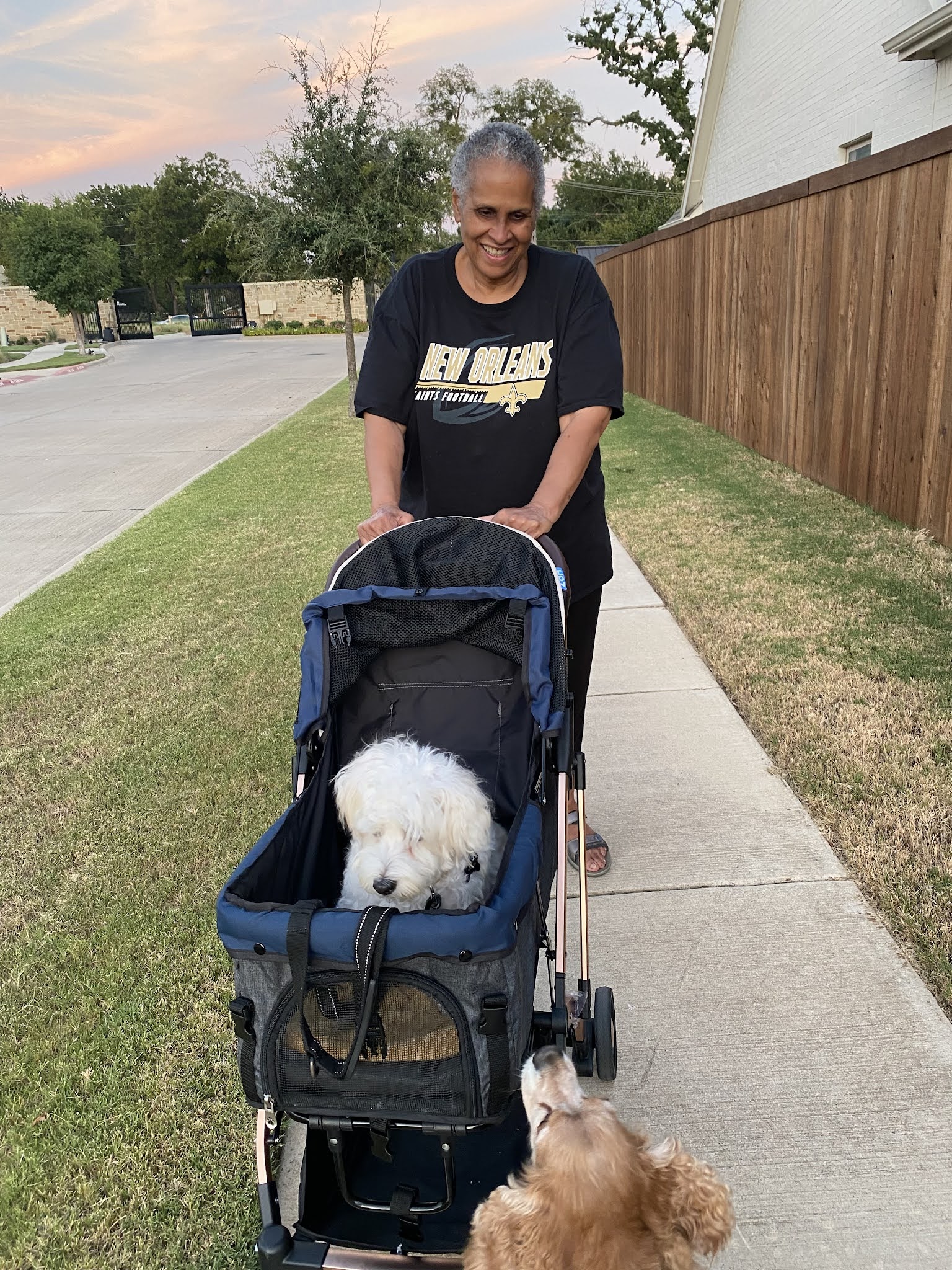
Currently we are hosting a dear friend of our family who evacuated from New Orleans to Fort Worth with her sister and two friends and Zeke, her little Maltese/Yorkie cross.  Zeke is such a good boy, and is adorable.  In just a couple short visits we have grown to love his momma and her family and friends.  

Zeke and his momma, whom we have easily grown to love
Rosco and Jackie investigating Zeke.  Before Zeke had to evacuate his home in New Orleans due to hurricane Ida, he was scheduled for surgery to repair a luxating patella. Zeke will have the necessary surgery once he gets back home, and for now he is making good use of his stroller:

Pearls:
  • Hurricane Ida has been scary to watch; we are grateful for the safety of our loved ones
  • Zeke is adorable; my first experience with a Maltese type and I’m in love
  • Zeke’s momma taught me how to make authentic New Orleans bread pudding, and cooked shrimp and grilled oysters, all of my favorite food!

Saturday, September 4, 2021

A Trip to the Veterinarian

Jackie has been with us three weeks! Yesterday I took her for her first appointment with our veterinarian Dr. J. Scott Mellina at Mellina Animal Hospital. He did an adoption exam and listened to her heart and lungs.  Dr. Mellina prescribed her ongoing heartworm and flea and tick prevention.  Since Jackie has been treated for heartworms recently, it is likely that she is still heartworm positive, so we will wait to do another occult heartworm test for another few months.

Due to concerns over covid and the new viral variants, Mellina Animal Hospital is continuing with their curbside service which I fully support and applaud. Dr. Mellina’s first comment (I stayed in the car and spoke with him over the phone from the parking lot) was what a nice dog Jackie is.  He wants her to continue on Heartguard (ivermectin) due to probably still being heartworm positive.  

When Dr. Mellina listened to Jackie’s heart and lungs, it sounded clear and healthy, with no indication of damage.  Of course that was great news to my ear.  Dr. Mellina took a radiograph of Jackie’s heart and lungs so we will have a baseline if anything changes in the future. 

When Kristen, Dr. Mellina’s veterinary technician, came out to the car to take Jackie in to see the veterinarian, Jackie calmly and confidently trotted in with Kristen.  After the appointment was over and Kristen returned Jackie to me in the parking lot at the car, Kristen reported that Jackie did great, wasn’t timid or scared at all, and received lots of pets and belly rubs from everyone.  It was good that Jackie only got petted and examined; she did not have to have anything invasive like shots or blood tests which helped add to the positive experience her first time in her new vet’s office. 

Since it was also Jackie’s first car ride with me, I had my treat pouch and was sure to reinforce Jackie for lying down quietly in the car.  Jackie handled the whole ride, visit, and return home brilliantly, and it was a positive experience for her first visit with her new veterinarian.

As a little positive reinforcement of my own to the veterinarian staff, I brought Dr. Mellina’s office a goody bag of apples, a variety of chocolates, some mixed nuts, my favorite chocolate dipped cookies, and a card expressing my sincere gratitude.  I am so grateful to the hardworking veterinarians and their staffs out there, keeping our animals healthy, caring for our family members, and adding value to lives every day.

Jackie being loved on by Vet Tech Kristen at Mellina Animal Hospital

Pearls:
  • Another milestone: Jackie has been in our home three weeks!
  • Jackie’s first veterinary visit went very well and was a positive experience 
  • Ongoing heartworm, flea and tick prevention were dispensed, and Dr. Mellina took a baseline radiograph of Jackie’s heart and lungs 
  • R+ works on people, too!
  • Any time I have the opportunity to do so, I thank my veterinarians and their staff 

Friday, September 3, 2021

Herding Instincts

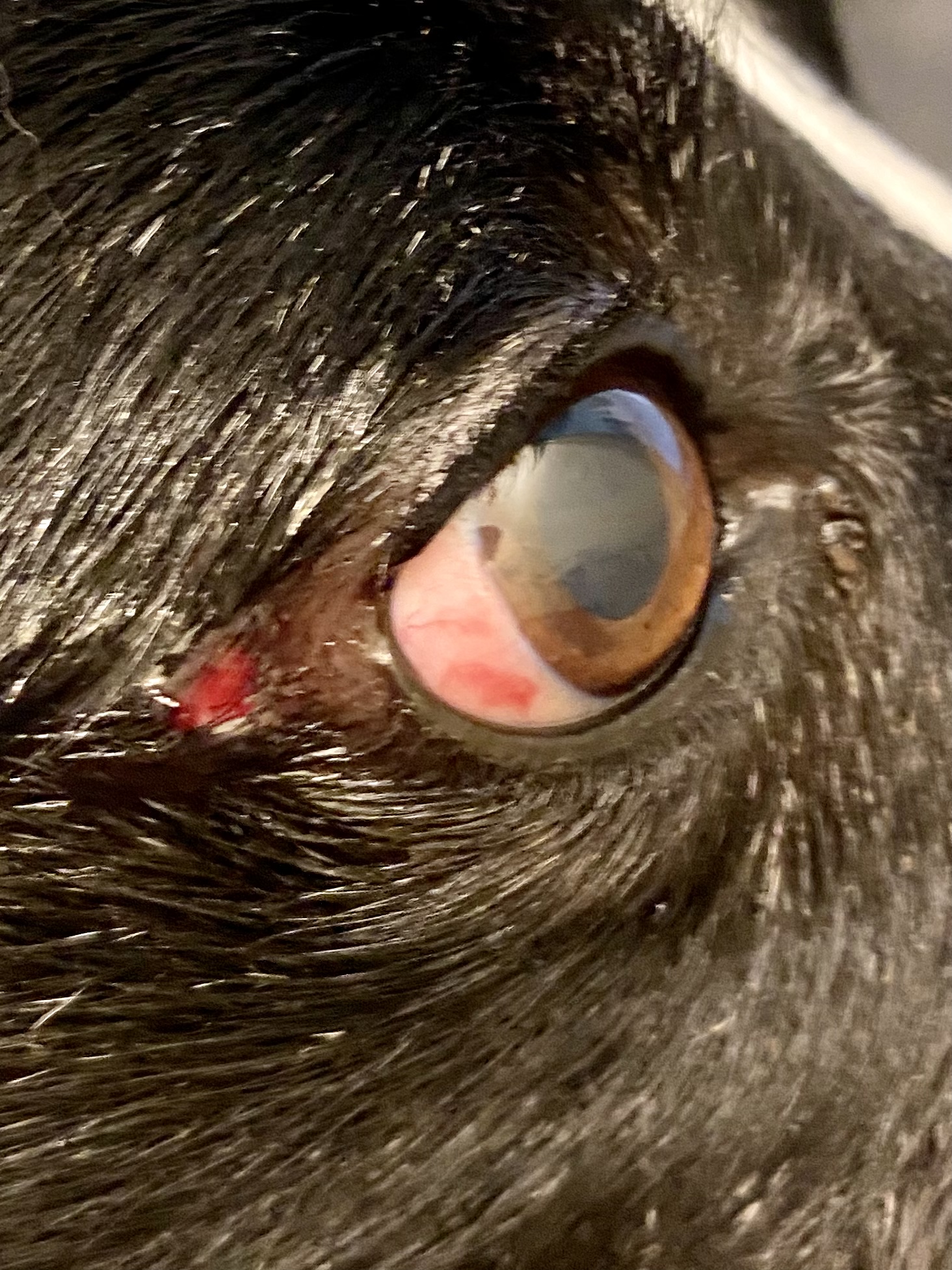
We’ve had our first casualty due to overly exuberant herding instincts.  Jackie loves to run, fast and hard, and she runs up to Gunner and bumps him with her snout.  It is an invitation to play, but yesterday things got a bit too boisterous and Jackie bumped into Gunner’s head too forcefully.  

While I don’t want to discourage Jackie’s high herding drive, I am also keen to control it for the benefit of all.  We have stepped up our efforts with recall training, sit, down, and stay.  I want to focus Jackie’s high drive, so am working with her on the basics while thinking ahead to foundation games for agility, such as touching a target or following a hand signal to walk over different surfaces.  

High herding drive can be awesome to work with in a dog, with the emphasis on work with.  Herding drive is not something I want to lay dormant to figuratively explode in my face later or be used for behavior in which I’m not interested. So I am working with Jackie to reinforce calm behavior between her brothers, allowing her to play with Gunner but only when he gives consent and only with no physical contact that is so rough.  

To reinforce gentleness I stand near Gunner and manage his personal space, reinforcing gentle behavior on Jackie’s part around Gunner.  It is definitely management at this point, with reinforcement added when applicable for gentle behavior near Gunner.  It is interesting to observe that Jackie is interested in bumping into and chasing Gunner, not Rosco; conversely, Gunner is only interested in bumping and chasing Rosco, not Jackie. Rosco likes to chase toys much more than chasing another dog.

Jackie has to have other possibilities to exert her herding drive, like running, and luring exercises where Jackie follows a target to get onto a mat or elevated surface.  Continued basic obedience training will also stimulate her brain, turning glucose into adenosine triphosphate (ATP) which will tire out a girl!

Gunner is going to be fine, and his eye is already less red than pictured here. Good old triple antibiotic ointment is always on hand for the rare bumps and scrapes life doles.


The best I could do at home without a microscope slit lamp camera— though I am a trained ophthalmic photographer, this is the first time I’ve documented eye pathology on a dog!

Pearls:
  • Hard play versus more sensitive nature = management required and work on reinforcing calm interactions
  • Gunner loves to herd Rosco, but is never forceful or rough; Rosco is quick to stand up for himself with swift retaliation in the form of a strong snarl and lunge if activities get too rough for his liking. Gunner on the other hand is more passive and shrinks when aggressive behavior is displayed toward himself; keeping Gunner and everyone safe and feeling confident is paramount 
  • Outlets for herding drive as well as brain games continue to be important
  • Triple antibiotic ointment has been a go-to solution for small scrapes in people, horses, and dogs

Tuesday, August 31, 2021

Be More Elegant

As an equestrian, one is often reminded to “be more elegant,” “sit up straighter,” “put your shoulder blades together,” or “make yourself taller.” In general, equestrians are called to walk a higher plain, both figuratively and literally.  Charles deKunffy espouses the idea that equestrians are called to live a noble life, and should aspire to live in an elite way.  Not elite as in entitled; rather, leading a noble existence where one’s lifestyle has meaning and elegance because one has an obligation to one’s horses, fellow equestrians, and the greater world.  An obligation to strive to improve, to seek knowledge, and to live in such a way that adds beauty and meaning to life.  

And then there are dogs.  Who themselves are noble, and all of the above striving still applies.  The thing is, part of the vernacular with dogs is not automatically a call to stand up straight nor make yourself taller as it is with horses. Indeed I find myself stooping, crouching, bending over much of the time time, and looking down at my dog to make eye contact or deliver treats and pats.

I am making a concerted effort to maintain the idea of moving like a dancer, walking and being tall, and being more elegant.  Even while lying in bed at night I’ve noticed my back feels more hunched lately, and that can’t be healthy.  Also as I sit in front of a screen, I remind myself to keep good posture.  While out walking the dogs, I walk tall and keep my shoulder blades together.  In an effort to stay fit and trim, I’ve increased my exercise routine. While I have to look down at my dogs, and bend over often, I still want to maintain good posture to the degree that I can. 

And I love the idea that animals call us to a higher purpose in life, and certainly subscribe to that ideal personally.  First, do no harm.  And then seek to be kinder, more graceful, more knowledgeable than I was yesterday, last week, a month ago. To grow.


“What is the house of Rohan, but a thatched barn where brigands drink in the reek, and their brats roll on the floor with their dogs?’                                                                                                                                 I don’t know, sounds like a pretty good Saturday night to me…

Rolling on the floor with the dogs sounds fun

Pearls:

  • Animals inspire a noble life; we have an obligation to them.  I personally owe a debt of gratitude to the horses and dogs in my life
  • Staying fit and trim is important
  • Primum nil nocere. Then act on our obligation to improve

Monday, August 30, 2021

Clicker Purchase

I bought a clicker this week.  I’ve never actually owned one before; in the past I have chosen to use operant conditioning with a verbal marker rather than a sound from a clicker as a marker, mostly for convenience because I always have my voice with me.  Using a verbal marker has worked well for me. Because I’ve used a verbal marker for so long with precise results, I feel my timing to mark the actual behavior is pretty good.

With Jackie’s clean slate, I am experimenting to see if I can improve my teaching.  Following Karen Pryor’s recommendations from her books Clicker Training for Dogs and Don’t Shoot the Dog, I spent a few minutes clicking-treating-clicking-treating with high value food treats to “charge” the clicker. When Jackie was tilting her head expectantly or otherwise indicating anticipation of the treat after the click, I knew the clicker was charged.  

I wanted to try the clicker with a novel behavior for Jackie— I picked “go to your place” since I hadn’t yet started to train that with her.  I put down a small square white cloth bath mat that I’ve used with Gunner to teach him “go to your place.” I began shaping with the clicker— the familiar one look toward the mat, click. One step toward the mat, click.  Walk to the mat and put a paw on, click. Walk to the mat with more than one paw, click.  Walk to the mat and sit- click.  Walk to the mat and linger a moment or two, click.  Walk to the mat and lie down, click. Etcetera until she was walking to the mat and lying on it.  It went well, of course it did, but I didn’t notice any appreciable difference using my voice marker versus the clicker, while indoors in a quiet room with no distractions. We trained that first session for about five minutes, maybe less, then we put away the clicker and carried on with our day.

I persevered the rest of that day and the next with three to five minute clicker training sessions, without a noticeable difference (between what I saw with Jackie now versus what I’ve experienced with training Gunner and other dogs with a verbal marker in the past) between a click or my voice while working indoors.  When we took it outside however, with interesting distractions and the ability to run and play, I did see increased response to the clicker.  While giving a click and treat for coming to me and making eye contact during play outside, Jackie seemed to respond more sharply to the click than a verbal marker, and she actively sought out attempts to get me to click.  

In an effort to be consistent, for now I am giving a food treat after every click (versus offering play or running as a treat).  But outdoors in a larger space, Jackie would knowingly offer the behavior I wanted— eye contact and coming to my front— get the click and then not be interested in the food treat.  Just the click was the reinforcement.  Which is awesome in that just wanting to know she has done “right” is a reinforcer. The work (probably for many dogs but especially for Border collies), and the knowledge they’ve done what the handler wants, becomes the reinforcement.

That’s all well and good but I’m a rule-follower so I’ve been sure to get the food treat in after the click, even if it means placing my hand on Jackie’s collar for a breath to give her the food treat after the click.  (I’ve been careful to make sure placing my hand on her collar is not experienced as aversive or negative in any way to Jackie, as that would be counterproductive to the entire process.) Being able to place a hand on a collar is a good behavior for Jackie to be reinforced for anyway. So yes, I did experience a difference in the training while using a clicker for outdoor, fast paced, on-the-run training sessions.  

Being new to the device itself, I’ve found the clicker… not cumbersome exactly, but it’s just one more thing I have to have on hand.  For example when we go for a stroll I have to gather my hat, change shoes, get the poop bags, make sure the bait pouch has enough treats, clip the treat bag on, get the leashes, and now pick up the clicker and hold it.  Everything is kept organized by the door in the mud room where I hang up the leashes and keep my shoes, so it’s not that much extra effort.  But I have to keep it in my hand and keep my thumb on the “trigger” so while I’m out walking three dogs that’s a good handful of items! (My years spent long-lining horses and riding with double reins in a full bridle has made me animal-dexterous!) So I am using the clicker when I want it, or to experiment with capturing or training new behaviors, but I’m still relying on my tried-and-true verbal marker as well.

This PetSafe Clik-R is the first clicker I’ve owned:


Pearls:
  • In an effort to test the efficacy of using a click-noise event marker versus a verbal marker for operant conditioning, I’m experimenting for the first time with an actual clicker
  • I purposely chose a clicker with a slightly softer sound than the traditional metal and plastic box clicker
  • My clicker has an elastic finger cuff so I can wear it like a ring, which I like especially while walking multiple dogs
  • It is early in my testing process, but it seems a clicker is very clear and understandable to the dog in a more distracting outdoor environment 
  • I will still train with a verbal marker, as I always have my voice with me
  • For now during each individual five minute or less training session, I use either a verbal marker or a clicker marker for the entirety of that individual session.  I haven’t yet decided if using two different markers interchangeably during the same five minute session is a good idea— more research into what trainers-whose-opinions-matter use is indicated 
Edited to add:
  • Using my verbal marker seems to be working better since I can precisely mark the event with my voice, saying “yes” just exactly at the precise moment the behavior I want is being displayed, not a moment before or after.  I find the clicker harder to control, since the “click” noise sounds just a fraction of a second after my thumb actually depresses the button— the clicker mechanism clicks on the upswing of my thumb, so I have to begin the depression of the button on the clicker a moment before the behavior occurs that I want to reinforce, which I find cumbersome 
  • I am sticking with my verbal marker, though I am open to the possibilities of using a clicker in certain circumstances 

Saturday, August 28, 2021

Another Anniversary

It’s been 14 days since Jackie came into our home and our hearts.  Today for the first time I groomed Jackie properly.  Of course I gave her lots of yummie treats when I picked her up and put her on the stainless steel grooming station, and continued to reinforce her while I brushed her, wiped her with a towel, and checked all her paws, in her ears, and all her nooks and crannies.  I knew she would let me do all the grooming, as I tested it perfunctorily during our meet-and-greet, but today I was still sure to reinforce her continued good behavior during grooming.

Jackie is continuing to relax and show her true personality.  She has never been extremely timid, but she is getting a bit bolder and comfortable in her new surroundings in general. I’ve continued incorporating reinforcing behaviors that will eventually become basic obedience such as sit, down, recall, eye contact, stay, walk beside me in heel position: the classics. She is implementing her own special “spots” in the house, for example she likes to stretch out underneath our teak breakfront.

Jackie is not shy really, she’s fairly outgoing, but she is sensitive.  She reacts a bit timidly at times to novel stimuli, but she recovers quickly and is willing to investigate.  In her limited interactions with neighborhood dogs she seems to be friendly and accepting. 

We’re still very much in early days, but I’m pleased with the progress we are making.

By definition a door is an object of which a dog is perpetually on the wrong side:

Finding her own niches in the house, in spite of numerous comfortable dog beds and sofas, Jackie has found her own spot underneath some furniture:
And she is amazing us with her sheer running speed!

Pearls:
  • Grooming sessions are best when short, frequent, and well reinforced with great treats before, during and after
  • Sometimes a newly adopted dog’s personality is slow to emerge; by two weeks we begin to see more of the true personality, but everything is still very new
  • Sensitive natures should be respected; patience is key


Friday, August 27, 2021

Keeping it Positive

There are many training methods that are effective, but as trainers and animal caregivers we should ask ourselves what is in the best interest of the dog? Even if a training style “works” is it still ok?  What are the best practices?

Let’s examine what we know: positive reinforcement training is scientifically proven to be quicker, longer lasting, and more effective in changing undesirable behavior and teaching dogs new behaviors, than is aversive training tactics (for example with electronic shock collars, which unfortunately I see in action almost daily). So even if a “trainer’s” endpoint of interest is just to “train a dog easily” or “quickly” or "correct bad behavior," they will still get there the fastest and have the most reliable results using positive reinforcement methods. 

Conversely, if your endpoint of interest is to have a great relationship with your dog, keeping them happy and mentally healthy, confident, and yes learn the behaviors that are important to you for sport or fun so they can win in life and amongst their peers, then R+ is your ally.

Here is how the American Veterinary Society of Animal Behavior sums it up:

“Based on current scientific evidence, the American Veterinary Society of Animal Behavior recommends that only reward-based training methods are used for all dog training, including the treatment of behavior problems. Aversive training methods have a damaging effect on both animal welfare and the human-animal bond. There is no evidence that aversive methods are more effective than reward-based methods in any context. AVSAB therefore advises that aversive methods should not be used in animal training or for the treatment of behavior disorders.”

Here is a list of peer-reviewed scientific publications to back up these ideas and support these statements, as well as the position statement on humane dog training from the American Veterinary Society of Animal Behavior published this year (2021): 

https://avsab.ftlbcdn.net/wp-content/uploads/2021/08/AVSAB-Humane-Dog-Training-Position-Statement-2021.pdf?fbclid=IwAR1_4liRtszoRiV3MKRKsLCWt7kkp1mRt3OkoyQOFKiXrwUp9PXweyZvJYs


A literature review showing science-based evidence that positive reinforcement training is more effective than aversive training:

1. Ziv G. The effects of using aversive training methods in dogs—A review. J Vet Behav Clin Appl Res. 2017;19:50-60.

2. Fernandes J, Olsson IA, de Castro A. Do aversive-based training methods actually compromise dog welfare?: A literature review. Appl Anim Behav Sci. 2017;196:1-12.

3. Makowska I. Review of dog training methods: welfare, learning ability, and current standards. https://spca.bc.ca/wp-content/uploads/dog-training- methods-review.pdf. Published 2018. Accessed September 1, 2020.

4. Vieira de Castro, AC, Fuchs D, Munhoz Morello G, Pastur S, de Sousa L, Olsson IAS. Does training method matter? Evidence for the negative impact of aversive-based methods on companion dog welfare. PloS one 2020;15(12): e0225023.

5. Deldalle S, Gaunet F. Effects of 2 training methods on stress-related behaviors of the dog (Canis familiaris) and on the dog–owner relationship. J Vet Behav. 2014;9(2):58-65.

6. Cooper JJ, Cracknell N, Hardiman J, Wright H, Mills D. The welfare consequences and efficacy of training pet dogs with remote electronic training collars in comparison to reward based training. PLoS One. 2014;9.9:e102722.

7. Haverbeke A, Laporte B, Depiereux E, Giffroy J-M, Diederich C. Training methods of military dog handlers and their effects on the team’s performances. Appl Anim Behav Sci. 2008;113(1-3):110-122.

8. Schilder MB, van der Borg JA. Training dogs with help of the shock collar: short and long term behavioural effects. Appl Anim Behav Sci. 2004;85(3- 4):319-334.

9. Arhant C, Bubna-Littitz H, Bartels A, Futschik A, Troxler J. Behaviour of smaller and larger dogs: Effects of training methods, inconsistency of owner behaviour and level of engagement in activities with the dog. Appl Anim Behav Sci. 2010;123(3-4):131-142.

10. Blackwell EJ, Bolster C, Richards G, Loftus BA, Casey RA. The use of electronic collars for training domestic dogs: estimated prevalence, reasons and risk factors for use, and owner perceived success as compared to other training methods. BMC Vet Res. 2012;8(1):93.

11. Casey RA, Loftus B, Bolster C, Richards GJ, Blackwell EJ. Human directed aggression in domestic dogs (Canis familiaris): Occurrence in different contexts and risk factors. Appl Anim Behav Sci 152, 52-63. 2014;152(52-63).

12. Casey RA, Loftus B, Bolster C, Richards GJ, Blackwell EJ. Inter-dog aggression in a UK owner survey: prevalence, co-occurrence in different contexts and risk factors. Vet Rec. 2013;172(5):127.

13. Herron ME, Shofer FS, Reisner IR. Survey of the use and outcome of confrontational and non-confrontational training methods in client-owned dogs showing undesired behaviors. Appl Anim Behav Sci. 2009;117(1- 2):47-54.

14. Hiby EF, Rooney NJ, Bradshaw JWS. Dog training methods: their use, effectiveness and interaction with behaviour and welfare. Anim Welf. 2004;13(1):63-69.

15. Reisner IR, Houpt KA, Shofer FS. National survey of owner-directed aggression in English Springer Spaniels. J Am Vet Med Assoc. 2005;227(10):1594-1603.

16. de Castro ACV, Barrett J, de Sousa L, Olsson IAS. Carrots versus sticks: The relationship between training methods and dog-owner attachment. Appl Anim Behav Sci. 2019;219:104831.

17. China L, Mills DS, Cooper JJ. Efficacy of Dog Training With and Without Remote Electronic Collars vs. a Focus on Positive Reinforcement. Front Vet Sci. 2020;7:508.

18. Rooney NJ, Cowan S. Training methods and owner-dog interactions: Links with dog behaviour and learning ability. Appl Anim Behav Sci. 2011;132(3-4):169-177.

19. Masson S, Nigron I, Gaultier E. Questionnaire survey on the use of

different e-collar types in France in everyday life with a view to providing recommendations for possible future regulations. J Vet Behav. 2018;26:48-60.

20. Mormède P, Andanson S, Aupérin B, et al. Exploration of the hypothalamic–pituitary–adrenal function as a tool to evaluate animal welfare. Physiol Behav. 2007;92(3):317-339.

21. Mills DS, Marchant-Forde JN, eds. The Encyclopedia of Applied Animal Behaviour and Welfare. CABI; 2010

Play is one of the best primary reinforcements for my group:

Pearls:

  • First, do no harm
  • Science supports the best practices of positive reinforcement (R+) training methods


Thursday, August 26, 2021

Positive Outcomes

Something bad happened.  But it had a good outcome and I want to write about it.  

The first several days Jackie was with us, she was in the living room minding her business when Rosco decided to have a grumpy grandpa moment.  In response to what he perceived as Jackie being too close to one of his plush toys, Rosco jumped on her snarling and snapping.  

In that moment my heart stopped— I had been being so vigilant with the introductions and managing the environment to assure something just like this would not occur.  Sometimes, in spite of all the managing and planning, you just happen to have luck on your side. That and a very good Border collie.  Jackie took the high road, calmly turning aside and loosely walking away, yielding the space and the toy (which she hadn’t even been interested in at that moment) to Rosco.  It allowed me to step in and diffuse Rosco. Jackie could easily have escalated the situation and retaliated, and with her age and size advantage over Rosco it could have been ugly.  

A credit to Jackie’s good nature and my sheer luck, Jackie chose to do the right thing.  It may be that she is still so new in the environment, but I’m hopeful it is an indication of emotional intelligence.  Time will tell but in the meantime I am taking no chances and continuing to manage the situation and work with Rosco to reduce resource-guarding behavior.

Today, several days after the Rosco grumpy episode, Jackie unintentionally met another neighborhood doodle.  (My neighborhood is seemingly full up with doodles.  I’m not sure what that says about me, and I’ll reserve my opinions about doodles to myself for the moment. To be fair my neighborhood also has goats, roosters, and horses so that's encouraging.) We were working on reinforcing voluntary behavior around the water when the very competent-swimming doodle swam across the entire river and right up to our more secluded beach area to say hello.  To his credit he was friendly, though a bit boisterous. I had several moments to prepare for his approach as we watched him swim easily across the river— I admit I was impressed with his swimming prowess.

Of course the doodle was instantly interested in Jackie.  She politely sideways-sniffed him, but he started being over-exuberant so she offered a low growl to let him know enough was enough.  I was able to easily change the subject and by then the doodle’s walker had called him back (many of the neighborhood dogs are out with their dog-nannies, which works in my favor since these career dog-walkers have proven to be dog-savvy and understand canine body language, and the importance of controlling their wards). So it was another good outcome for Jackie, and I’m grateful she stands up for herself but has the good sense not to escalate anything beyond a growl.  Yes of course it is up to me to protect my dog and ensure constructive circumstances, but it is reassuring knowing my dog is actively trying to be helpful.

Pearls:

  • Always stack the cards in your favor, but sometimes you just need a little luck in spite of everything
  • A savvy, well-adjusted emotionally intelligent dog is a godsend
  • It's proven very helpful to have a good number of perspicacious dog trainers in the immediate neighborhood; so far interactions with neighborhood dogs have gone very well
The trail on our less-trafficked side of the river leading to a beach we can swim by ourselves for now:

In the morning hours during weekdays, the dog crowd on the river tends to be well versed in good behavior etiquette, which I very much appreciate.  I've been impressed with the level of education most of the neighborhood dogs display:


Swimming Lessons

Some Border collies love water. And I was under the impression that most mammals instinctively know how to swim. However swimming lessons are going slowly with Gunner.  Well before adopting Jackie I started working with Gunner in the pool in gradually increasing depths of water from a few inches to just deep enough to dog paddle.  Rosco is an accomplished swimmer and will happily dive in to retrieve tennis balls. I discovered with Gunner that he dangles his hind legs and only half-heartedly dog paddles with his front legs— certainly not enough to keep himself afloat.  So we’ve been working on that.

Since we’ve made a recent move, we’ve transferred our swimming lessons to a safe beachy area of the Trinity River. In this Texas heat it is a welcome reprieve while out for a stroll. My pre-conceived notion was that herding dogs will hop into water— like ponds or stock tanks— in order to cool off.  My previous herding dogs all did this, and loved to swim as well.

Gunner looks suspiciously at any body of water.  We know that Gunner was picked up by the city dog pound in Galveston as a stray before being boosted from a high kill shelter by All Border Collie Rescue. Does Gunner have fear related to water since Galveston is on the gulf?  I’ll never know but I’ve been very deliberate in introducing Gunner to water and swimming in a fear-free, positive manner.

I’d like to get both Border collies comfortable with swimming, for many reasons including it’s just plain fun, and it’s a great way to cool off and get some exercise. I love this low-impact activity especially for Rosco in his golden years.  

The first few times we approached the beach area on the river, I reinforced Jackie for just walking near the water.  When she was comfortable with that over a couple days I reinforced her for walking along the water’s edge in the sand.  Today for the first time she stepped her front paws into the water so I reinforced that.  It is always her decision and if she wants to retreat she is allowed.  Gunner is at the point where he will get in up to his belly, and if I’m in with him he will dog paddle with his front legs and let his hind legs dangle, but only enough to turn around to go back to the shore.  

It’s going much slower than I expected, and that’s okay because we’re having fun, and getting in some confidence-building education while it is still so hot during the day.

Pearls:

  • Some herding dogs are born loving water, some need to be taught to love it
  • Give a dog confidence by going slowly and allowing the dog freedom to make their own decisions, and reinforce volunteer behavior incrementally building confidence for the new activity
  • A Spaniel out-performing a Border collie?  I’m here to tell ya it happens
  • Living on a river has proven to be interesting and fun
On the Trinity River:


A river friend we weren’t so sure about: