Wednesday, October 6, 2021

Relationship

In considering Jackie’s and my own educational odyssey, and comparing that to Gunner’s background, it occurs to me that the reason I thought agility was so easy when I first started with Gunner several months ago was due to our strong relationship.  Gunner was nine years old and had been in my life four years before we ever took our first agility lesson.  Gunner’s natural personality is a velcro dog; he was dialed in to me from the very beginning because of this trait. Our relationship allowed us to jump right in to agility, making it seem easy.

Jackie and I are still in the very early stages of developing our relationship.  Jackie’s personality is friendly and easy with everyone she’s met, but it will take time for us to develop the deep bond that Gunner and I enjoy and that makes training feel seamless. Jackie’s personality is definitely more independent and patient; she is happy to quietly entertain herself with a chew bone or a good nap, or even just gazing interestedly at her environment, for long periods of time.  Gunner is much more demanding of one-on-one interaction, and wants to be engaged with my full attention as much and as often as possible.

Gunner stays focused on me and my cues, yet is able to work independently using objects in the environment as cues (such as agility equipment, for example), and easily moves between focusing on me to independently focusing on his surroundings (like jumping up on a wall or walking up a narrow ramp), and back again. 

Pacing, exposing her belly, remaining in one spot, walking away to lay down, staying inside her crate, are all signals Jackie is using to tell me our relationship needs more time to develop.  It is interesting that in seemingly more distracting environments, such as while walking along the trafficked river trails, Jackie seems to enjoy training more. There is less direct pressure while traveling together along a trail versus when working alone in a fixed environment. 

This week we are experimenting with playing in a variety of different places, including indoors at home, outdoors at home, and outdoors in different places.  So far Jackie’s favorite place is along the trails while we are going for a stroll with her brothers. It is a very relaxed feeling we all share, and has the added bonus of being able to keep moving, sniffing and exploring between each behavior that we’re practicing.

Pearls:

  • My endpoint of interest is a great relationship with my dog; education games, while fun, are secondary
  • Gunner and I have a great relationship that has been forged over many years and countless interactions from spending a very great amount of time together 
  • Zero pressure games and education environments where Jackie volunteers to engage is my goal with Jackie as we continue to develop an august relationship 

Jackie, we’re getting there slowly but surely

Tuesday, October 5, 2021

Foundations for Agility Week 4

Jackie is continuing to gain experience in the classroom setting.  Our homework this week includes touch a hand target in the the 3, 4, 5, and 6 clock positions while standing.  This is to reinforce looking down to the ground surface while standing. We will continue to work on 123 go, and add send to a target.  

Send to a target is to reinforce distance and working out in front of the handler. With Jackie in a sit stay, I walk out to a ceramic target and place a treat, then return to Jackie and send her to the target with “Break! Go, go, go!” while pointing at the target with my hand closest to the dog. Jackie runs past me to the target and is reinforced by eating the treat off the target.

Our coach suggested we work on 123 go and send to a target with slightly increasing distractions. In other words, start indoors, then move to the back yard, then maybe the park, then the flat surface of the river trail, to begin to get Jackie used to playing in different settings and locations. 

Jackie with her brothers

Jackie on the river trail:

Pearls:

  • Homework this week includes nose touch a hand target in the 3, 4, 5, and 6 clock positions while standing, 123 go, and send to a target from sit stay with “Break! Go go go!”
  • Jackie can begin to play foundation games in different environments such as indoors, the back yard, the park, and the river trail in order to gain confidence to play in various locations

Monday, October 4, 2021

Old Stories

It has come to my attention that less chatter during training sessions can be beneficial.  When our coach suggested I try not saying quite as much to Jackie “Oh what a goood girl!  WHAT a very good doggy! Oh yes she’s a very CLEVER girl” during a training session, I was able to intentionally be more quiet and less chatty.  

Which leads me to examine, where is the good spot between plain “noise” that has to be filtered by the dog, and “enthusiasm” and cheerfulness that dogs love and respond to well. It seems to me that enthusiasm should be shown after the primary reinforcement is given, in a celebratory manner.  

My mom, god rest her, successfully trained several cocker spaniels, a black lab, a boxer, and a Great Dane, (and even had a pet fox when she was a child in the 1940s) during the 60s, 70s and 80s. In her defense, Mom, like most dog trainers of that era, did not know about R+ training, and so she used the best that she knew.  

The best that Mom knew was a choke chain and giving corrections, I’m sorry to say.  The thing that Mom did get right at the time, and much to her own intuition, was the Barbara Woodhouse style of training that used lots of praise in a high pitched sing-songy voice to encourage the dog. “WHAT a gooooood dog!” was used by Mom with much enthusiasm to praise all good efforts and “WAAALKIES” to encourage energetic heeling.

It’s kind of astonishing, when I think about it now, that Mom was so very successful in teaching dogs using almost zero treats or toys, but with her voice (and yikes a choke chain) alone.  Mom taught our dogs many clever “circus dog” tricks. Mom even taught our Cocker spaniel Buffy to open and close the back door of our house using a specialized doggy-level door handle my mom designed and my dad, an engineer, built for her. One time our Cocker spaniel jumped through the screened window, breaking the screen and frustrating my mom. So she went about solving the problem by teaching the dog to open the door by itself. 

Mom even taught the neighbor’s dog to “go lie down on your porch” from our own yard, in response to the neighbor’s Great Dane barking loudly and running up and down the fence line.  Instead, Mom taught the dog (completely unbeknownst to it’s owner) that on the cue of hearing the back door of our porch slam shut, the neighbor’s Dane trotted from wherever he was in his own yard and lay down on his own porch as long as Mom was out there.  She did it using aversive methods, but in the 70s and 80s that was still how almost all dog training was taught, unfortunately. 

Mom used what she knew with great results.  I’m convinced if she had had R+ in her repertoire, Mom would have been an even better dog trainer, and she was pretty darn good even with just the enthusiastic sound of her voice and lots of verbal praise.

Flash forward to my basic obedience class this week, where gratefully I have positive reinforcement as my ally, and no longer have to rely exclusively on the excitement level of my enthusiastic tone of voice. Rather, I am being intentional about celebrating enthusiastically but keeping my cues calm and clear.

A pastel pencil drawing of Mom while she was studying English literature at Colorado State University, where she graduated from in 1958:


Pearls:
  • When educating a dog, reserve high pitched “chatter” for praise and celebration after the cue has been carried out and after the primary reinforcer has been given
  • Having positive reinforcement as an ally has been life changing for so many, and I’m grateful that when we know better, we can do better 
  • I am being intentionally more quiet while working with Jackie, while still maintaining energy and enthusiasm 
Heartbreaking footage of Barbara Woodhouse using a choke chain on a 4 month old tiny dog. Note the ongoing “chatter” that Fifi has to tune out, but that Ms. Woodhouse is using to encourage the dog as best she could. This was typical of exactly the same way my own mom used to train her dogs. 
https://youtube.com/watch?v=psOMiAkDu0k&feature=share
Now we know better, and I’m grateful for science based modern training.


Friday, October 1, 2021

Rally O

Gunner and I started our first Rally Obedience class this week.  Gunner did extremely well, considering his handicap of a handler!  In class we reviewed sit stay while the handler walks around, down stay while the handler walks around, sit in front position with front tuck-sits to the handler, and moving the hindquarters around a pivot point to improve precision heeling.

Our homework this week will be to polish our sit stay. Gunner has learned so many tricks involving waving or raising his front paws that he tends to hover his paws over the ground in anticipation.  For a proper AKC stay, all four paws must stay firmly planted on the ground. So we will be working on reinforcing true stays this week.

The pivot around a platform was one of Gunner’s advanced trick title tricks, but of course I taught him to move away from the handler. For Rally, the dog learns to pivot into or toward the handler in heel position.  So that took a few minutes to unscramble in class but I have some good ideas now on how to reinforce the hindquarters pivoting toward the handler for heeling pivots around a platform.

It felt good being in a classroom with Gunner again! He did so well with stamina and was keen and eager to go to work, and never got tired.  Unfortunately a big thunderstorm followed by lots of rain and lightening happened in the middle of class. Gunner, like many Border collies, shuts down during thunderstorms, so that was unfortunate.  But we persevered the best we could, and have lots of ideas for homework this week.

Gunner ready to play

Pearls:
  • Gunner started Rally O class, and we’re loving it
  • Homework includes reviewing sit, down, stand, sit stay and down stay while the handler walks around the dog, reinforcing for sitting in front position and reinforcing front tuck-sits, reinforcing being in heel position, and pivoting the hindquarters around a platform
  • Paws firmly planted for stays will be reinforced, and pivots around a platform will be based on my hands being directly in front of Gunner’s nose
  • Bait pouches are good hooked to the handler’s backside, this way the dog never knows where the treat is coming from and the dog doesn’t get involved in staring at the bait pouch rather than looking at the handler
  • When reinforcing heel position, use your left hand slightly to the left of the dog’s nose to avoid the dog’s hindquarters splaying out away from the handler and to be sure the dog’s hindquarters are balanced in toward the handler


Thursday, September 30, 2021

Basic Obedience Week Three

Today in basic obedience Jackie was much brighter and ready to work at the beginning of class, and I attribute that to giving her a couple days completely off. The last couple days we’ve done absolutely nothing, other than go for walks and out to play in the yard.  No cues given, no expectations to educate, just purely time to either rest or sniff while out playing or walking. My plan forward is to continue with this theme of doing a lot of nothing.  Active inactivity.  

That said, our homework this week includes sit stay while the handler walks around the dog, loose leash walking, “go to your place” which is lying on a mat, and starting recall.  We will continue to practice sit, down, and nose touch a hand target. My plan going forward is to give Jackie a lot more downtime, and a lot less novel experiences and education.

Reader, I’m learning things about dog adoption and Border collies I never even considered before.  But isn’t that true learning?  With the benefit of seven weeks of hindsight, and as I am beginning to understand Jackie’s personality more each week, Jackie is telling me that she needs to slow down, and have more time. 

In a sincere belief that a young Border collie would need lots of activity, brain games, walking and playing, I was prepared to offer all of it when we adopted Jackie into our home.  I will never know for sure, but speculation about Jackie’s previous life leads me to consider that in rural Mississippi it’s possible that Jackie didn’t really do much herding, training games, leash walks in novel environments, or maybe much of anything at all.  For all I know, Jackie slept under a porch for 20 hours a day, and experienced the exact same environment every day for the other four. Who knows?

Taking into account she was just spayed five months ago, underwent heartworm treatment two months ago, has been in three different rescues across three states, and has changed homes three times just during her most recent tenure in Texas with Border Collie Save, it is important to evaluate a plan forward.  Jackie has demonstrated a personality that is capable of and even craves quiet time, and time to observe her environment and continue to get to know her new siblings and family.

Jackie has a very cuddly personality, but she is self reliant in a way some other dogs, such as my current Border collie Gunner and my previous Aussie Roo, are not.  Gunner (as was Roo) is definitely a velcro dog, while Jackie is more self confident, though still very outgoing and loving, she is happy to spend quiet time, and is willing to rest her body and brain.

The bonding process, or the process that forges a close relationship, is moving at a much different pace with Jackie than it has with previous dogs.  I am continuing to learn her personality, and to give her however much time it takes for us to form a bond.  It is becoming clear that Jackie needs more time to rest and decompress between playing games and learning new things.  

Jackie is a fast learner, to be sure, but she is clearly letting me know that down time, and time spent sleeping and resting, is necessary for her.  She is happy to be active and loves to run, but she is also very happy being indoors on the sofa or bed just being together, or “hanging out” as it were.  Which makes her an awesome house pet!  Jackie has the potential to make a great agility dog because she loves to run and play, but for now I will continue to allow her the time she needs to regenerate, and allow Jackie to form a deeper bond with me and the rest of her new family.  

There is no pressure or timeline, I sincerely continue to have Jackie’s best interest at heart.  I am learning anew that every dog is different.  This young, athletic Border collie has shown me that while she loves being active, there also has to be plenty of time to decompress and allow us to continue to forge our relationship.

Pearls:

  • Our homework this week includes continuing sit, down, and nose touch, and beginning sit stay and down stay while creating distance, “go to your place,” loose leash walking, and recall
  • Jackie is her own personality and I am learning to slow down to allow her more time 
  • What I thought I knew about young, athletic Border collies is changing as I continue to learn, one size does not fit all and I’m grateful for excellent teachers

Jackie is teaching me that not all Border collies fit the same mold, to be mindful of the present, and that one does not have to be always on the move

Wednesday, September 29, 2021

You Never Know What You’ll See on the Trinity River

We see many interesting things during our hikes along the Trinity River.  It’s been a lifesaver to have access to so much natural area along the river trails for the dogs to explore, run, and help maintain fitness. We often see herons, hawks, turtles, jumping fish, snakes, gar fish, horses, spiders, and we’ve met several dog folks too.  

Jackie had her first horse and rider sighting tonight, and she was all ears.  She was interested to be sure, and she did a great job choosing to return her focus back to me. 

The trails are especially beautiful during sunset, and I’m looking forward to spending even more time out there as the fall weather continues to cool a bit. 

Some views from along the river in our neighborhood:


Jackie was all ears when she saw her first horse and rider:


Our nephew skipping rocks at sunset:


Pearls:

  • The Trinity River and its wilderness trails are a jewel
  • We’ve seen and met some interesting folks during our hikes 
  • Cooler fall weather is just around the corner, and we’re ready to enjoy it

Tuesday, September 28, 2021

Foundations for Agility Week 3, and lessons I didn't anticipate

Our Agility Foundations homework this week includes beginning the 123 go game: practicing a sit stay, then walking ahead of Jackie a few paces while maintaining eye contact so we stay engaged (with her on my left side), giving her release cue "break!" while I remain still, then running forward and rewarding her with a treat from my left hand as she runs to catch up with me (being sure to start with the treat in the other hand and moving it to the hand nearest Jackie after I've started running).  Then repeating the game with Jackie on my right side and giving the reinforcement from my right hand.

One way to create arousal is by tugging with a toy.  Jackie is not yet interested in toys, she is barely even interested in food, so this is a work in progress.  In class today while the other teams were working on tugging, Jackie was more interested in gazing at the other dogs than engaging with a tug toy or treats. Playing nose touch a hand target games and "get it" games with treats tossed on the floor give Jackie the option to decide if she wants to engage with the game, or if she prefers to wait in her crate.  It may be that I will need to engage in nose touch a hand target and "get it" games for a few repetitions over time until such time Jackie gains confidence and chooses she wants to play outside of her crate.  It is her decision, and the best I can do is make it easy and fun for her by playing the simpler hand touch or get it game, and give her time.

In class today Jackie performed a brilliant sit stay, and didn't budge when I gave the release word. Additionally, she was nervous about being outside of her crate while everyone else was crated, and was in general a bit timid and over-faced.  Which gives us some good information: 1) That Jackie needs to be allowed to choose to engage, and that includes giving her time and freedom to decide she wants to play, 2) That Jackie needs clarity to understand what the release word means, and 3) That Jackie needs time to learn a single behavior, and focus on a single cue until she understands that individual element, without stacking more than one behavior at a time. In other words, Jackie needs to learn the very simplest element of a game before we can even begin to do more.  We need to get one simple thing right in order to do the more complex behavior later. Simple games like hand touch a target or get it may help give Jackie more confidence over time.

In making a recent move from a more humid climate to the drier climate in which we live now, I have discovered a novel challenge I never dealt with in Houston-- static electricity.  When working on nose touch a hand target this week, Jackie's nose got mildly shocked right at the sensitive tip of her nose when she touched my hand. She didn't like that; neither did I. So I will make a concerted effort to discharge built-up static electricity each time before I zap her; it was an unpleasant experience, and not one I am interested in repeating.

Our agility coach is going above and beyond in her patience and guidance, and I am grateful.  I'm discovering that the prospectus of what I had in mind to learn with Jackie is evolving into Jackie actually teaching me more about patience, decision-making, and consent than I ever knew I needed.  I'm definitely learning some valuable insights.  It turns out the lessons Jackie is teaching aren't necessarily the ones I wanted to learn, but they are the ones I need to learn.

Experience with past herding dogs and Border collies has taught me that the more you teach, the better they love to learn.  In a very sincere effort to give my new adoptee the enrichment and engagement my perception of what a young Border collie needs, I've tried to do all the things: play, stuffed kong toys, long-lasting chews, lickit mats, interactive toys, a long menu of possible reinforcing treats, games, operant conditioning, long walks and runs, swimming, clicker training, various substrates and environments to explore, lots of pets and cuddle time.... yada yada yada.  Maybe Jackie just needs a day off?  Go for a walk, and relax around the house to continue to build a relationship.  Maybe relationships don't have to include such a long list, maybe just being together is enough?

I'm trying to learn what I should, I really am.  And Jackie is a wonderful teacher.


Pearls:

  • What I set out to learn is not moving along the linear path I had envisioned, but Jackie is teaching me valuable lessons
  • Agility Foundations homework this week includes: continuing to work on reinforcing stand-stay, playing tug and let go-- which may be a work in progress for later, and 123 go game to begin practicing agility course starts
  • Static electricity was not an ally this week, now I know to discharge extra static while training before I touch Jackie
  • A coach who truly has your own and your dog's best interest at heart is a godsend 


Friday, September 24, 2021

Consent

Verbalizing the idea of a dog giving consent into an organized definition and conversation is relatively new to me.  There has been much recent discussion on dogs giving their consent, and that consent is a basic right of every sentient being. I feel like I've always had the idea of an animal giving its consent, with dogs but also with horses. It's practically impossible for a ~120-pound H. sapiens to get ~1,500-pound equine to do, well anything, without the equid first consenting to do the behavior. So the idea of an animal giving consent is familiar.

Our dog agility coach talked about consent in very simple terms, and I loved how she described it.  Basically, when using operant conditioning using positive reinforcement (often abbreviated as R+), when we give a cue for a behavior, the dog has a choice as to whether or not the dog wants to perform the behavior. She doesn't have to do the behavior. Nothing bad happens to the dog should she not do the behavior. However when the dog does choose to do the behavior, it learns that all sorts of good things happen as a consequence of doing the behavior.

We know behaviors followed by reinforcement will be strengthened, and be more likely to occur again in the future. It turns out that science supports positive reinforcement as the most efficient way to educate an animal.  It's great that the fastest, most reliable way to teach an animal is also the most fun and humane way, for both the learner and the teacher.

Rijkens consenting to carry me around

Pearls:

  • It seems natural to me to consider consent after working with Rijkens and other horses.  Good ol’ Rijkens was 1,500 pounds on a lean day, and happily consented to do many things
  • Take care when considering consent, if the dog chooses not to do the behavior for which the handler cues and is reinforced by something else for ignoring the handler, the likelihood of ignoring the cue again in the future increases 
  • The handler is best off setting up training scenarios that guarantee a 100% success rate, and the dog soon knows that all sorts of good things happen when they choose to follow the handler’s cues

Tuna Blondies

In the ongoing saga to find an irresistible reinforcer for Jackie, this week I tried a recipe shared by another dog trainer, my friend Marcella Ward of Dogs Speak Dog Training. Here's a link to her recipe. Marcella calls hers Tuna Fudge, but with the minor tweaks I made to the recipe mine were more like Tuna Blondies.

I started with best quality ingredients, and made a few modifications.  Since Gunner is on a heart-healthy diet, I used pink Himalayan garlic salt, and only used a very easy teaspoon. I quadrupled the freshly grated Parmigiano Reggiano cheese (I cheese from the heart), and the extra dry volume of the cheese enabled me to use only a tablespoon or so of flour, just enough to stabilize the mixture. I used a good heavy-handed 3 tablespoons of pumpkin to ward off any tummy issues.

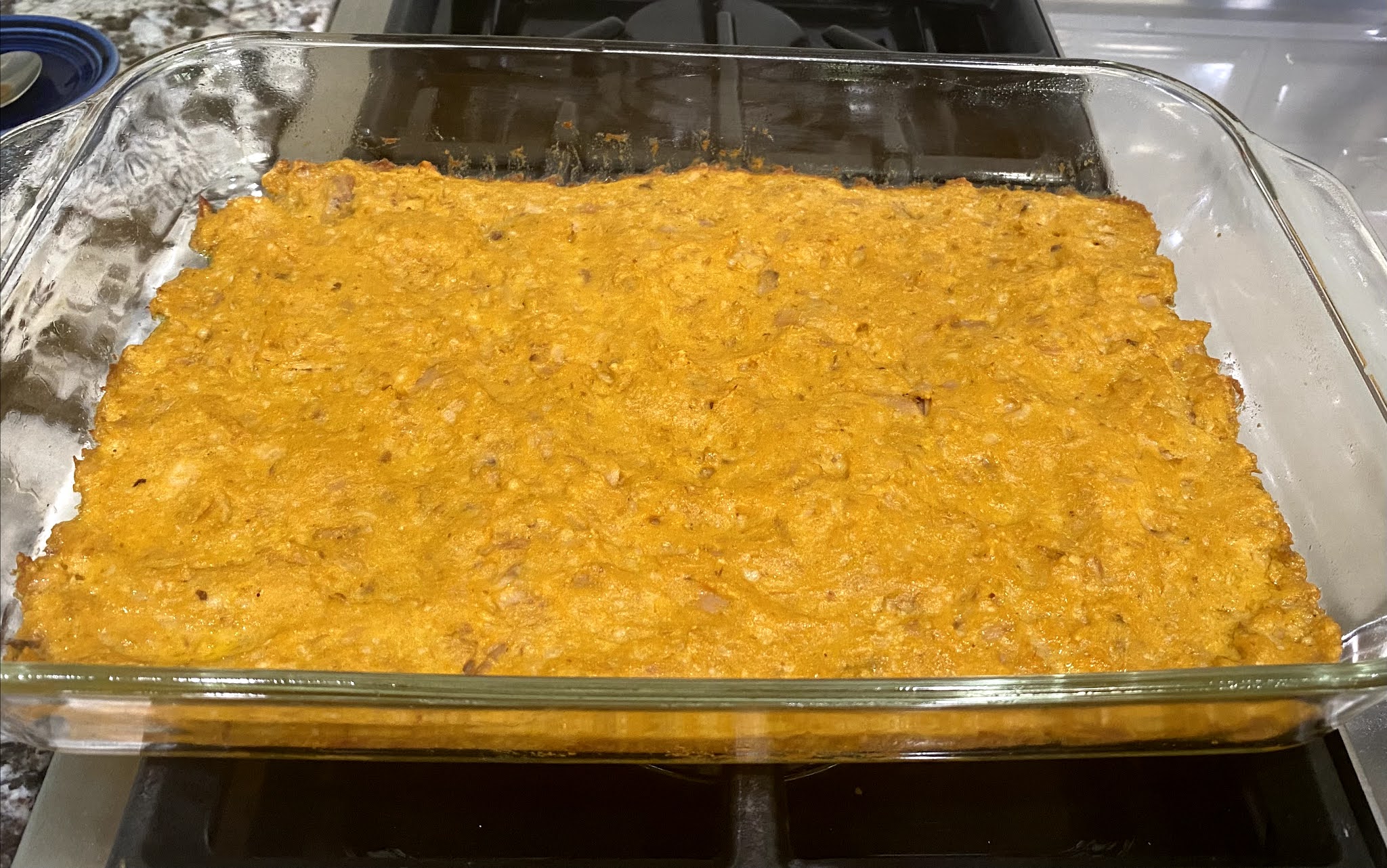
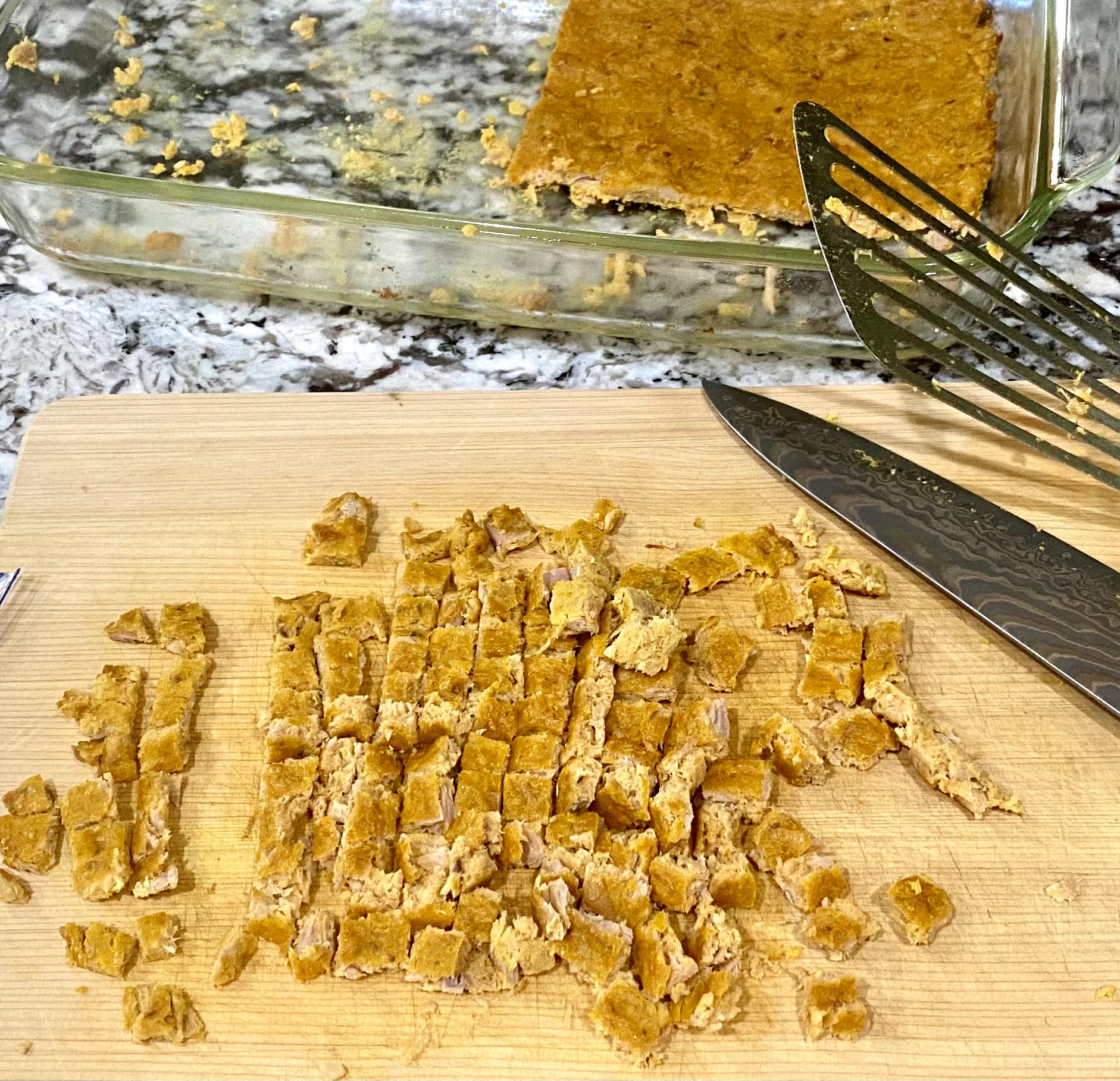
I very generously greased the pan with olive oil, which was good because the tuna blondies came out easily without sticking to the pan. The mixture spread very thinly in a 9" x 13" dish, which made it perfect for cutting into very small pencil eraser-sized cubes after it was baked.

Initial results are very favorable! Jackie even approached me while I was cutting up the Tuna Blondies to engage me with attention-seeking behavior, which is welcome. Between the Parmigiano Reggiano cheese and the tuna, this was a stinky (in a good way!) endeavor.  Gunner loves it too, and it is one of the highest value treats I've discovered for Jackie.

Starting with good ingredients:

Be sure to generously grease the pan, and don't worry how thinly it spreads, it didn't stick to the pan:

The extra pumpkin and the small amount of pink salt gave it a nice color:

The blondies lifted nicely from the pan with a spatula, and were thin enough to be cut into pencil eraser sized bites:

Jackie came 'round to investigate what the smell was:

Pearls:
  • Tuna Blondies are stinky and high-value for Jackie
  • Thank you Marcella of Dogs Speak Dog Training for sharing the Tuna Fudge recipe!
  • Tuna Blondies modified recipe is as follows:
Tuna Blondies
     2 five-ounce cans of tuna-- 1 in oil, 1 in water, drain the water and some of the oil
     2 eggs
     1 tsp garlic Himalayan pink salt
     4 Tbsp freshly grated Parmigiano Reggiano cheese
     Flour (enough for brownie consistency, about 1 Tbsp)
     3 Tbsp of pure canned pumpkin

Mix ingredients in a bowl.  Generously grease a 9" x 13" baking pan and spread the blondie mixture very thinly into the pan using a spoon or rubber spatula.  Bake for 20 minutes at 350 degrees F.  Allow the blondies to cool and cut into desired pieces.  Store in the fridge for up to 1 week and in the freezer up to 1 month. Pumpkin is added because these treats can be quite rich.


Raised by Wolves

Thanks to some very patient and long suffering dressage trainers, I’ve managed to learn one or two things about horses.  When it comes to formal training of dogs however, I’ve been figuratively (literally?) raised by wolves.  

After having about a 15 year break from formal dog training to immerse myself in dressage, I started my agility odyssey again with Gunner in earnest back in Houston several months ago. Quickly I realized during my first agility lessons that I didn’t really understand any of it, but that was ok, I embraced the journey of being a beginner.  Now that I am a couple weeks into starting Jackie, I am becoming very aware of how much I know that I don’t know.  

But reader, that is precisely what draws me to the formal training, and what makes it so exhilarating! I’ve used operant conditioning with positive reinforcement to teach multiple dogs many things, including AKC canine good citizen titles on several dogs, multiple AKC trick dog titles, and training and certification of a pet therapy dog for visiting nursing homes and rehabilitation hospitals; as well as using R+ successfully to train good all-around manners to many animals, including a rat, a bunny, and several horses.

Now that I’m seeking formal training again for myself while I train my dogs, it occurs to me I’ve been using an effective, though fairly disorganized, method.  I use my own body language, noises, and made up words.  Though it is organized and understood between my dogs and me, it is definitely a roughshod method compared to the formal classroom setting in which I am currently.  Learning to use a clicker as a marker versus using a word as a marker is so much harder than it seems it should be.  And I’m teaching myself a new release word too, adding to the juggle.

Today during a discussion about Clever Hans the counting horse it occurred to me that I probably often give involuntary cues via body language.  Which of course, everyone does, but it is interesting to me to see how much effort I am having to exert to teach Jackie simple cues like “sit,” “down,” and touch a hand target, that I’ve previously seemingly effortlessly taught other animals in the past.  

No matter, I will keep striving and learning.  And frankly, this is what makes it so interesting to persue positive reinforcement and learn ever more about the fascinating subject of animal cognition.  And if I ever get to run at an agility trial or perform in the obedience ring with a dog?  Well that’s just some awesome lagniappe!


Pearls:
  • Operant conditioning using R+ is so user friendly it is easy to be successful, even when one goes rogue
  • I know what I know (very little), and I know how very much I don’t know.  What I don’t know is what I don’t know that I don’t know.  But never mind, keep learning
  • Involuntary cues are just that, involuntary, and I’m trying to get control of my volunteers