Tuesday, April 16, 2024

Meet Lizzie

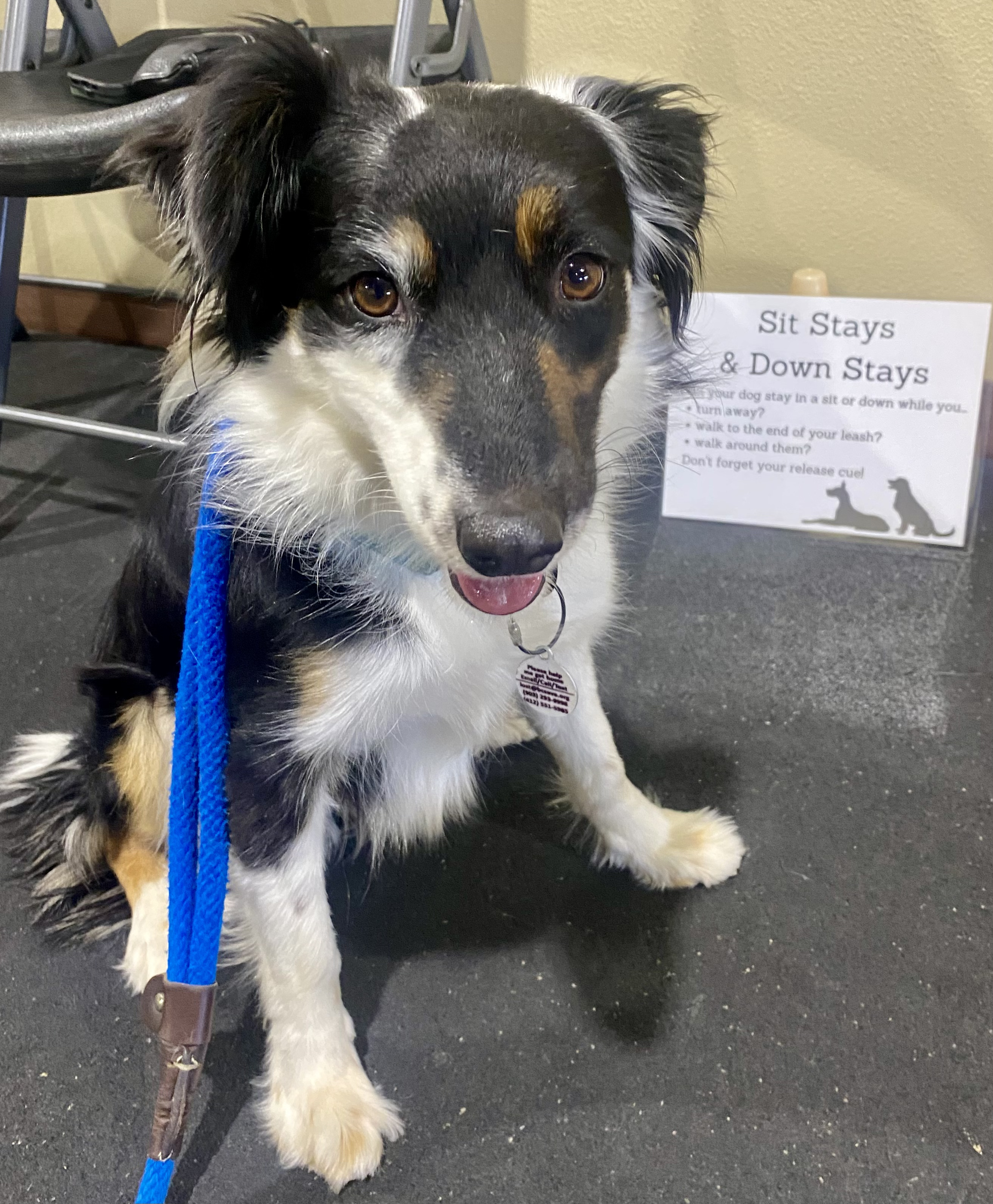
Our newest BCSave foster, Lizzie, is one of the happiest pups I've known. Part border collie. Maybe part Aussie? Maybe part guardian-type? 100% lovable. 

Lizzie was surrendered to the Pearl River County SPCA in Picayune, Mississippi with three un-weaned puppies in tow. Heartworm positive and still intact, Lizzie has a few important medical milestones to meet and will then be ready to find her permanent family.

Lizzie's stats:

  • ~Three years old
  • 43 pounds
  • Border collie mix
  • Incredibly sweet temperament, with a great off-switch, and settles well
  • Good with people and dogs
  • Medium energy level
  • Food-motivated for R+ learning
  • Loves water!
  • Crate-trained and potty-trained
Apply today to adopt this delightful dog through BCSave.


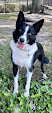
Lizzie playing in the park:

Wednesday, March 27, 2024

Thoughts on Punishment as Related to Scholarly Study

The Certification Council for Professional Dog Trainers uses the least intrusive and minimally aversive procedure to succeed in training or changing behavior. It is called LIMA, or "Least Intrusive, Minimally Aversive."

Why not, as a body of leaders in behavior, instead of striving for the least intrusive, minimally aversive behavior intervention, why not strive for the most reinforcing, optimally appetitive behavior intervention? 

I realize the ask is big. We must rely on available education, intelligence, and hopefully our desire for the best possible relationship with our dogs.

I want to be honest about the fact that I use punishment and know what I am doing, rather than just hoping I always use reinforcement. I also want to recognize when I am using an aversive, not just with dogs but with human students and colleagues, as I am about to do here by voicing my disapproval (a positive punishment [P+] reprimand) of the target behavior defined as "using fear or pain."

Ironic, because I am engaging in the P+ of trying to reduce the frequency of using P+ by voicing my disapproval of P+. I am intentionally trying to be self-aware, civil, thoughtful, and scholarly in tone as I do so.

In general I agree with Dr. Ian Dunbar's teachings, especially that rewards are always preferred and appropriate behavior must always be taught to the dog and available to produce to avoid punishment. Dr. Ian Dunbar says repeating punishment of any kind beyond three repetitions is ABUSE. This seems a very good principle.

In general I disagree with Steve White's "rules" because it's unfair to do something (especially punishment) the dog does not expect. I will also thoughtfully note the multiple errors in spelling ("loosing" in rule three) and grammar (ending a sentence in a preposition in rule four) which do not inspire scholarly confidence.

We learn by scholarly study and in real-life practice, that for punishment to even be effective, it must be immediate and certain. Unless one is 100% able to deliver the punishment 100% of the time the target behavior occurs, then don't bother. Otherwise it becomes an intermittent reinforcer, thus strengthening the very behavior we wish to diminish!

Considered in light of scholarly study, this makes me re-examine my use of punishment. If indeed I cannot follow through with delivering the punishment every single time and not repeating beyond three repetitions, then I must strongly consider stopping the use of that particular punishment, ever. No matter how un-painful or fear-free I consider it to be.

See Dr. Ian Dunbar's eighth rule of punishment and his idea that punishment beyond three repetitions is abuse. If an educated, respected, well-known, and scientifically sound expert scholar says it's abuse, it probably is.

I strive to only use punishment that is not painful and not scary but is effective. However unless I can honestly apply it 100% of the time, and repeat it less than three times, I will consider not using punishment for that behavior.

Examples of my use of punishment and aversives follow:

Positive punishment: physically preventing my dog from performing a behavior that will hurt him by physically grabbing him (providing a consequence [a physical grab] that decreases the frequency of the target behavior [hurting himself, say getting run over by a tractor if he cannot hear me]). P+ is to be used only at the utmost end of need.

Negative punishment: crossing my arms and looking up if a dog tries to jump up on me when the dog's guardian does not want the dog to jump up on people (removing the reinforcer [my attention] to reduce the frequency of the behavior [jumping up]).

Negative reinforcement: walking away from my dog if he gets excited while in the crate while I approach to release him from the crate (providing aversive consequences [I walk away, something my dog will work to avoid] to maintain or increase the behavior [Gunner stays quietly lying down in his crate until released]).

Positive reinforcement: where I choose to spend most of my efforts.

For my part, I do not want to incur the heavy responsibility, as Sue Alexander rightly puts it in her Applied Behavior Analysis course, of using pain to teach a dog. 

I prefer to rely on the four quadrants of reinforcement and punishment (without fear or pain), as well as my intelligence, experience, and if necessary consulting a colleague whose opinion matters, to develop a plan to attain the behavior I desire that's in the best interest of the dog and our relationship.

If we find ourselves in a situation where we are considering using fear or pain, we must re-examine what we know, including what is known by respected and scientifically sound experts. When necessary, reach out to a colleague or expert peer for the appropriate help. 

Yes, even for fence jumping, life-saving off-leash recall, harming chickens, and the like. Modern science supports positive reinforcement and optimally appetitive behavior intervention.

Given enough thought, effort, and the right brain power, there is almost always a better alternative than using fear or pain.


Our foster dog Meggie, who in a past life endured too much fear and pain. Now she is benefitting from a positive reinforcement education.

Wednesday, March 13, 2024

Counterconditioning: A Crash Course

Counterconditioning by Playing

the Look At That Game 

Keep your dog below threshold, still showing quiet and calm behavior, while you teach your dog to look at the exciting or fearful stimulus, then repeatedly reward them for remaining calm while just in the presence of the trigger.

Have lots of high-value rewards your dog loves, like pea-sized bits of hot dog or chicken. Be sure you are at a distance and time where you control how close or far your dog is from the trigger. 

Always keep your dog under threshold (showing quiet and calm behavior), so they notice the trigger without going over threshold. Sometimes this means starting at a very far distance from the trigger. 

If your dog isn't able to see the trigger at any distance without going over threshold, that's ok. Practice first at home with a neutral target (anything that they do not react to) so that they learn the game before being in the presence of the trigger. 

As soon as your dog glances at the trigger, click or say "Yes!" while your dog looks at the trigger to mark that behavior and give them a delicious treat. After your dog progresses to the point they are offering a glance toward the trigger, add the verbal cue "Look!" 

Your dog quickly starts to look at the scary or stimulating trigger when you give the "Look!" cue and then eagerly turns to you in anticipation of a tasty tidbit (which you always provide!). 

Continue rewarding their bravery, and keep sessions short by using less than five to 10 repetitions at a time. Give your dog frequent re-set breaks and make each session brief and positive. Keep practicing this game until your dog is calmly looking at the trigger and then back at you in anticipation of the reward. 

Gradually and incrementally decrease the distance to the trigger over time. Always keep enough distance so that your dog remains under threshold. 

The end goal is a conditioned emotional response so that your dog remains calm when they see the trigger. Eventually the dog glances at the trigger and looks back at you, then you click and treat while the dog looks at your face

Your dog now has a calm conditioned response while in the presence of what used to be their trigger. 

What Is Counterconditioning

Anyway?

Counterconditioning literally means opposite learning. It's the process of modifying behavior through a new association with a stimulus of an opposite emotional affect. 

When a dog feels fear, aggression, or excitement about a particular stimulus, the dog is counterconditioned (learns the opposite emotion) to feel comfort, friendliness, or calm toward the same stimulus.

A classic example is the fear of men. Many dogs, for a multitude of reasons (sometimes the reason is unknown due to an event that occurred in the dog's past, sometimes the reason is obvious; counterconditioning works either way) have a fear of men.

Pix was successfully counterconditioned from fearing her new dad to loving him

The dog has learned to feel fear when in the presence of men. In counterconditioning, the dog learns the opposite feeling when in the presence of men: the dog learns to feel comfortable.

Counterconditioning is achieved by keeping enough distance between the dog and the trigger (in this case a strange man) so that the dog stays under threshold, or still showing quiet and calm behavior, while providing things the dog finds enjoyable and valuable while in the presence of the trigger. 

How Counterconditioning Works

Anytime the dog is anywhere in the presence of the trigger and is still under threshold, toss your dog treats they find highly valuable. Often boiled chicken or any other food your dog finds delicious works well as a reward. 

Over time and several repetitions, the dog eventually learns to associate the wonderful feeling that good things happen whenever they're in the presence of strange men. 

At first the dog only receives treats from the trusted handler. Remain in this phase for however long it takes for the dog to remain calm within visual distance of the trigger. 

Gradually progress from the dog receiving treats tossed from the trusted handler to the man tossing food treats in the dog's direction, at first from a distance while walking calmly past the dog. Over time as the dog becomes more comfortable the man tosses treats gradually closer to the dog. 

Be sure the dog stays under threshold. Remember the dog does not have to interact with, be petted by, or do anything with the man. 

The dog does not have to sit or perform any specific behavior. The only criteria is that the dog stays calm while in visible distance of the trigger, and is rewarded for remaining calm. 

This process worked well with our foster dog Pix.

Pix could not even be in the same room with my spouse Chris when we first got her without fearfully growling at Chris and cowering away. Within 23 days of operation "When I See Dad Chicken Rains From The Sky" (counterconditioning) Pix was nudging under Chris' hand to ask him to pet her and Chris was able to pat her all over, scratch her ears, and Pix even slept next to him in bed.

This same process worked with other strange men including our pool cleaner, our gardener, and eventually Pix's new dad when she was adopted successfully into her forever home. 

Pix in the mid-phase of counterconditioning. She voluntarily approached Chris and lay at his side. When Dad's around, wonderful things happen!

Pearls:

  • Keep enough distance so your dog remains calm while rewarding them for noticing the trigger.
  •  Practice with a neutral target at home if needed before introducing the trigger.
  • Click or say "Yes!" and reward them when your dog glances at the trigger, then add the verbal cue "Look!"
  • Reward bravery and keep sessions short and positive.
  • Provide frequent breaks and maintain positivity while teaching.
  • Gradually decrease the distance to the trigger while being sure your dog is far enough away to remain calm.
  • A positive emotional response where your dog remains calm in the presence of the trigger is built with conditioned positive feelings associated with what used to be the trigger.

Questions? Comment here, I'm happy to offer suggestions to get you started teaching your dog to feel better about their triggers. 


Tuesday, March 12, 2024

First Things First

Yay! You've Adopted a Rescue!

You just adopted a border collie. So let's do the things: Walks! Hikes! Frisbee! Picnics! Even dog sports, right?

Wrong. Or rather, not just yet. Your newly adopted rescue dog needs time, typically about three months but sometimes even longer with high-intensity herders. 

Time to fully decompress, learn the house rules, continue counter-conditioning, form positive emotional responses to everything new around them, and begin the bonding process with you, their new family. 

Two rescue dogs at different waypoints in their respective journeys

Seven Tips to Improve Your Odds

Here are seven tips to improve your odds before adopting a dog that needs remedial socialization (adapted from Pat Miller's Do Over Dogs: Give Your Dog a Second Chance for a First Class Life):

1. Have a solid understanding of counter-conditioning, desensitization, and conditioning positive emotional responses. Make a strong commitment to practice these with them every single day

2. Read Do Over Dogs by Pat Miller, The Cautious Canine by Patricia McConnell, Help For Your Fearful Dog by Nicole Wilde, and Dogs Are From Neptune by Jean Donaldson. Acquire solid training manuals like Excel-erated Learning by Pamela Reid and Before and After Getting Your Puppy by Dr. Ian Dunbar.

3. Be prepared to assertively protect your dog from unwanted advances by well-meaning strangers. Do not allow people or their dogs to interact with or approach your dog until your dog is well-socialized enough to tolerate interaction and approaching.

4. Know that love is not enough. Many well-meaning adopters believe that giving a psychologically neglected pup a home filled with love is enough to "fix" the problem. Don't fool yourself. Love is an important part of the equation, but it takes a lot of work too.

5. Be prepared for heartache. Some under-socialized dogs -- most likely those who are genetically sound -- do respond well to remedial socialization and turn into reasonably well-socialized companions. Others don't. If you don't succeed in enhancing your dog's social skills, are you prepared to live with a fearful dog who might be at risk for snapping -- you, visitors, children? 

6. Think long and hard before opening your heart to a do-over-dog that has unusual behavioral needs, high drive, or rehabbing. If you fail them, they may not get another chance.

7. Remember there are gradations of energy levels, drive, and personalities among rescue dogs. You do as much of a good thing by adopting a dog with small issues as you do one with large challenges. Both dogs are in desperate need of a human to call their own, one who won't give up easily on them, and one who will at the right point in their lives, whether sooner or later, be there to give them a gentle goodbye.

Allow Time To Establish Safety and Comfort

Modern, scientific, and common sense dog training rejects any use of compulsion or aversive tools. However from Applied Dog Behavior and Training Volume Three by Steven Lindsay, we still know that "loss of safety and comfort mediates escape behavior and defensive aggression." A decrease in reward promotes increased arousal, scanning, and vigilance, whereas reward-based training using positive reinforcement intensifies attention and interest, promoting fearless seeking and exploratory activities. 

Any newly adopted dog in the first days and weeks surely experiences feelings of loss of safety and comfort, at least early on. Allowing time for feelings of increased safety and comfort to be established, combined with ongoing positive counter-conditioning to achieve positive conditioned emotional responses sets up our dogs for success in their new home. 

Reach out to me if you need ideas on implementing counter-conditioning and creating positive conditioned emotional responses. As a rescue volunteer, I want every dog to find the perfect fit.

It's okay to accept your dog for who they are. Pat Miller says like a good marriage, the best dog guardians enter into a relationship with expectations about their new canine partners. If the journey reveals a different path, they adjust accordingly and still fulfill the social contract they made to love them "until death do us part." 

These are humans who know how to love their dogs. Every dog should be blessed with at least one, for the rest of their life.  

The author and her now right-hand dog, once a repeat rescue that boomeranged into her life

Pearls:


The TOP TWO ideas to implement when adopting a dog:
  • Patience. Allow enough quiet, in-home, one-on-one bonding time, starting with a minimum of three months, for your new dog to decompress, learn the house rules, and continue learning positive conditioned emotional responses.
  • Positive reinforcement. Use counterconditioning, desensitization, and simple reward-based training games to establish feelings of safety and comfort for your new dog.

Monday, March 4, 2024

Treibball with Jackie: Five Successful Pens

Jackie, as with all things, is very gentle with her sheep. But she is getting good practice gathering and penning during treibball.

Pearls:

  • The handler keeps her back centered toward the goal so the dog is directed by your body language to herd the correct direction toward the pen. Always pay the dog when they are oriented directly toward the pen.
  • Homework includes starting down with distance. Add the cue of the handler's arm held straight up above their head.
Jackie making successful gathers and pens:


Practice, practice, practice!


Tuesday, February 27, 2024

Hubris

 https://www.facebook.com/crystal.g.howse/posts/pfbid0X8M8DJ6mwc3yGYqfySUgk2JM16iZiVeg7DTnYqqrVz6we3Rbnu8CnCbQ7rSyqfaQl

From a public social media post concerning online grumblings about perceived barriers to adopting dogs from rescue, and my rebuttal:

"Many of you have seen that I have a Saint Bernard puppy now. The dog of my dreams that I have wanted since I was a toddler. Im going to start posting pictures of her shamelessly because she is the most precious potato! Here's what I have to say about her:
I bought my dog.
The moment I bought my dog, I hated myself for it and initially felt like I owed myself, and everyone I work with in rescue an explanation.
Barriers to entry is something we talk about in my program at MSU. Barriers to entry, in my job's sense, regard what makes it to where a student can't get into college.
Some of those barriers are - low socioeconomic status, first Gen students who don't have guidance from their parents, lack of access to resources like a vehicle, meal plan, residence hall, etc.
Well now let's talk about barriers to entry for animal adoption....
I bought my dog....that seems, to me as a rescuer, like a horrible thing to say
She is my dream dog. I am going to love and cherish her until the day she leaves me. But, that being said; I have been trying to ADOPT a Saint Bernard for several years now. I have been following Saint Bernard Rescue pages on Facebook. I have been looking on Petfinder at adoptions only. I have been messaging rescues and sending in applications. I have looked at Saint Bernards to rescue all the way from puppies to seniors. I didn't care what age, background, or area the dog came from. I just wanted to rescue one. Adopt don't shop right?
After being denied by every single rescue that I have reached out to because of (what I consider) superficial reasons, I bought my dog.
I have sent my adoption resume, WITH REFERENCES, to at least 7 Saint Bernard rescues, stating that I have been HEAVILY involved in rescue for 10+ years now, have a fenced in yard, have a home where the dog will be indoors almost always - aside from potty breaks, walks, adventures, and excursions. I have submitted that I've done my research on the breed, have never surrendered one of my pets to a shelter, would not surrender this pet to a shelter and would give back to the rescue IF I HAD to for some reason.
....But I wasn't good enough according to their standards. So I bought this dog of mine that is my dream dog. I don't think I would ever "buy" a dog again, now that I've gotten my dream puppy. But a conversation is seriously to be had about barriers to adoption.
If I can't adopt a dog with my rescue background, my animal science education, my dedication to animal welfare, my dedication to a pitbull that I owned and refused to give up, and HUNTED breed friendly housing for, for 3 different moves, my keeping all of my animals for 3+ moves and loving them unconditionally. My proof of annual vet care AND THEN SOME to all my babies. Despite the size of my yard, my house, or my free time, .... we have a problem in the adoption world.
We need to do better. For the animals."
[sic]


Animal Accolade's response:


Barriers to adoption may (or may not) be high, based on anecdotal stories like this one, and the usual pile on of "this one time" that follows. But based on true, quantifiable statistics (which I'll reference below), too many dogs are neglected, abandoned, ever find permanent homes, or worse, in the US.

So yes, rescue personnel err on the side of caution, but please understand it is from a need of protection for the dogs. If one is denied seven times from reputable, trustworthy rescues, perhaps one should search thyself. Never having purchased a dog, I have instead had good luck adopting from breed rescue.

For rescue personnel it's always about the dogs' well-being, never about the feelings of the human, except to the extent that a good match is made into a promising, stable, and appropriate long-term home.

Presumably all the Saint Bernard dogs from this story were adopted into long-term, appropriate homes, so that should be a win for all concerned. It's all about the dogs' security, in the absence of human hubris that landed them in rescue in the first place.

Purchase a dog for all the right reasons if you see fit. But please be fair and open-minded toward rescue by avoiding openly denigrating rescue, who are volunteers doing the best we can with extremely limited resources, "for the animals."

On this we agree: we certainly "have a problem in the adoption world." A sad 2.7 million problems every year.

Real, quantifiable statistics:
  1. Only 1 out of every 10 dogs born will find a permanent home.[1]
  2. The main reasons animals are in shelters: owners give them up, or animal control finds them on the street.[2]
  3. Each year, approximately 2.7 million dogs and cats are killed every year because shelters are too full and there aren’t enough adoptive homes. Act as a publicist for your local shelter so pets can find homes. Sign up for Shelter Pet PR.[3]
  4. Approximately 7.6 million companion animals enter animal shelters nationwide every year. Of those, approximately 3.9 million are dogs and 3.4 million are cats.[4]
  5. According to the National Council on Pet Population Study and Policy (NCPPSP), less than 2% of cats and only 15 to 20% of dogs are returned to their owners.[5]
  6. 25% of dogs that enter local shelters are purebred.[6]
  7. About twice as many animals enter shelters as strays compared to the number that are relinquished by their owners.[7]
  8. It’s impossible to determine how many stray dogs and cats live in the United States. Estimates for cats alone range up to 70 million.[8]
  9. Only 10% of the animals received by shelters have been spayed or neutered. Overpopulation, due to owners letting their pets accidentally or intentionally reproduce, sees millions of these “excess” animals killed annually.[9]
  10. Many strays are lost pets that were not kept properly indoors or provided with identification.[10]
  11. According to The Humane Society, there are about 3,500 brick-and-mortar animal shelters in the US and 10,000 rescue groups and animal sanctuaries in North America.[11]

  1. The Mosby Foundation. "Truth of what happens to shelter animals everyday." Web Accessed February 23, 2015. ↩︎

  2. Towell, Lisa. "Why People Abandon Animals." PETA Prime, 2010. Web Accessed February 23, 2015. ↩︎

  3. American Society for the Prevention of Cruelty to Animals. "Pet Statistics." Web Accessed February 26, 2015. ↩︎

  4. American Society for the Prevention of Cruelty to Animals. "Pet Statistics." Web Accessed February 26, 2015. ↩︎

  5. American Society for the Prevention of Cruelty to Animals. "Pet Statistics." Web Accessed February 26, 2015. ↩︎

  6. The Humane Society of the United States. "U.S. Pet Ownership and Shelter Population Estimates." 2012 & 2013. Web Accessed February 23, 2015. ↩︎

  7. American Society for the Prevention of Cruelty to Animals. "Pet Statistics." Web Accessed February 26, 2015. ↩︎

  8. American Society for the Prevention of Cruelty to Animals. "Pet Statistics." Web Accessed February 26, 2015. ↩︎

  9. American Society for the Prevention of Cruelty to Animals. "Pet Statistics." Web Accessed February 26, 2015. ↩︎

  10. American Society for the Prevention of Cruelty to Animals. "Pet Statistics." Web Accessed February 26, 2015. ↩︎

  11. The Humane Society. "Pets by the numbers." Web Accessed February 20, 2019. ↩︎


For my part, I wish we could all agree that rescues aren't the problem, and the few good, ethical, responsible breeders aren't the problem. The dog abandonment (and worse) crisis we face is a multi-faceted problem. The solution surely begins with being a responsible guardian for the animals in our care.

Sunday, February 25, 2024

Meggie Graduation from Basic Manners

Meggie aced her Basic Manners group class at Lucky Dog Training, graduating with honors! We covered a lot of ground in this six-week class and I'm so proud of how well Meggie handles the training environment!

Pearls:

Among several other cues and behaviors, in Basic Manners class Meggie has perfected:

  • "Place!" Going to place on cue from six feet away and going into down on place, then waiting until the release cue to get up, even with distractions.
  • Loose Leash Walking. Meggie walks in heel position with a loose, looped leash in a figure 8 around two cones. (Meggie's whale eye is because something to the side of her was competing for her attention. Meggie was being a good girl and keeping her body focused forward on the handler. She was not displaying stress in this photo, but rather displaying a moment of split attention.)
  • Recall (including Emergency Recall). Meggie plays the "Get it!" game and while she is turned away from the handler running away she whips back to the handler when she hears "Meggie here!"
  • Sit Stay and Down Stay. Meggie happily holds a sit or down while I walk to the end of her leash, turn my back on her, or walk around her. She is then released with the cue "Break!"
  • Wait at the Door. Meggie remains in sit while I open the door and walk through. When she is released with her cue "Break!" Meggie is allowed to walk through the doorway.
  • Leave It. When Meggie sees something dropped on the floor, she avoids taking it in her mouth and is instead rewarded for looking up at her handler.


This highly talented and extremely intelligent pup is available for adoption through BCSAVE.


Saturday, February 24, 2024

Treibball with Jackie: Successful Gathers, Fetches, and Pens

Jackie is making headway in figuring out the treibball experience. She did a great job today doing elemental gathers, fetches, and pens. 

Pearls:

  • When sending your dog with "Go out!" and during play, keep your back centered to the goal so your dog has the optimum chance to push the ball directly into the goal. Jackie is reinforced for pushing the ball directly toward the handler, so use your body to help your dog direct the ball into the goal.
  • Homework includes continuing to reinforce "Go out!" with distance, continue reinforcing "Whoah!" to indicate standing still, and begin teaching "Down!" from a distance.
  • A good visual cue for "Down!" is the handler raising one arm straight up above their head. This is a very clear visual cue that the dog can understand at long distances and with noise distractions such as wind. 


Jackie making successful gathers, fetches, and pens:


Treibball is to herding what pickleball is the tennis. 
That's okay, it's still FUN! Not everyone has 40 acres and a flock of sheep.