Wednesday, September 4, 2013

Goals

When looking forward toward developing a goal, we obviously believe it is do-able or we may not have set the goal to begin with.  Looking back at a goal once it has been accomplished, it seems relatively simple in the rear-view mirror.  But during a goal, while in the trenches actually churning out the work, the goal can feel so difficult and at times even un-attainable.

Reaching my bronze medal has been such a journey, but looking back on the cold hard stats puts it in perspective:
  • Total of five weekend shows with Delphi
  • Total of three weekend shows with Rijkens
  • Total of thirty-two months from start to finish
I've always considered the adage "a level per year" and thought that I was falling so short.  However when viewed from show-ring-ready as the endpoint of interest, the actual data support that oft quoted time frame: to learn to compete at a satisfactory level in first, second and third level it took me a little over two and a half years.

If it takes the great masters decades to learn to ride, what makes me think I can do it in any less time?  I'm grateful for the opportunity to learn real dressage, no shortcuts.  Regardless of how many years (or decades!) it takes, I'm committed for the long haul.

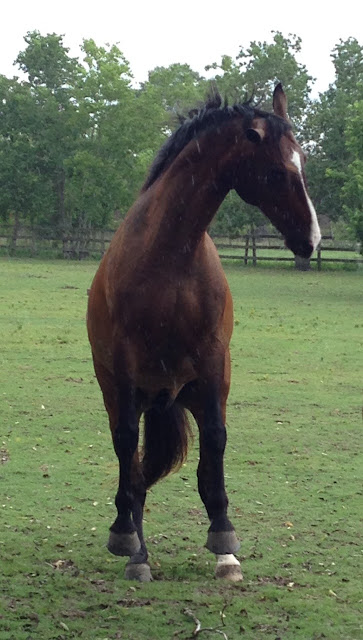
 He doesn't stay up nights calculating goals and worrying about shows!  Rijkens playing with a buddy in the rain earlier this week:


To commemorate my USDF bronze medal, I've ordered these high waist Pikeur breeches from London.  In color "bronze" of course!


Monday, September 2, 2013

Bronze Medal!

Rijkens completed our final score requirement at third level at this weekend's HDS labor day show.

Accolades also go to Delphinia, my Trakehner mare (who has a wonderful new mom in Dallas).  Delphi and I went to our first USEF recognized show in October 2010 where judge General Burton gave us our initial qualifying score at first level.  From there Delphi earned three of the six legs required in first and second level.  Delphi and I went to a total of five weekend shows together.

Rijkens took over in the spring of 2013 to finish the final three scores at second and third level, and did it within the three weekend shows we've been to as a team.  So after two and a half years of hard work and striving, I've earned my USDF bronze medal!

Importantly, my trainer Karen Brown has been with me in the trenches schooling my horses, teaching me to train and ride; being mentor, coach and guide.  Karen has been my trainer for eight years, and these last two years I've been at her side almost daily.  I owe a debt of gratitude to Karen, and always will.
Medal threesome: Rijkens, Delphi and me in July 2012
Here's the photo I want to use for the USDF Yearbook; not another froufrou dressage pose, rather just a girl on a farm having fun with her horses!


Karen, Rijkens and me at Windy Knoll Spring 2013

Karen showing Rijkens at Prix St Georges Summer 2013


Monday, August 12, 2013

Grateful

Karen Brown and I had a wonderful experience with Rijkens and Juno at this weekend's Belle Terre Farm show.  Winning both his tests handily with a 61.4 in Prix St Georges and 67.69 in third level test three, Rijkens still had plenty of energy to spare for my third level ride after Karen started him in Prix St Georges.

Juno too was well into the sixties in first level and training level, winning his first level test and coming in a close reserve in training level against another fancy horse that scored in the 70's.

So thankful to Karen for piloting Rijkens to FEI success and supporting me as I rode Rijkens in our best test yet!  So proud of our boys Juno and Rijkens!

The breed differences of these two best friends, a Holsteiner and an Andalusian, are readily apparent side by side in the trailer!

First trick out of the hat, Juno wins first level in the deep sixties.

To the victors go the spoils; loafing in the shade with your best buddy that is.

Rijkens and Juno posing with their well-earned swag.

Juno says "Yeah, I'm a champion.  What else did you expect!"

Taking names and kicking ass; Karen dominated everything from FEI to training level all in the same day!


Thursday, July 25, 2013

Trailride on Cheyenne Mountain

During a recent stay at the Broadmoor in Colorado Springs,

View from our window

View from our building

View from hotel

View of Cheyenne mountains from hotel
I had an opportunity to trail ride through the Cheyenne mountains.

The rustic (no running water or flushable toilets) and charming Stables at the Broadmoor, which of course weren't AT the Broadmoor, were a scenic drive up one mountain, down the other side, and halfway up the next mountain.
On the way to the ranch

View from Old Stage Road

The five mile drive up Old Stage Road took 40 minutes due to the constant mountain switchbacks, and also due to me having to pull over every few minutes to gape at the unbelievably gorgeous mountain views.

Scott, who lives and works at the ranch, was my guide on the mountain trail
Our guide, with my horse's ear in corner
and if I thought rugged mountain cowboys aren't as sentimental about their horses as are we dressage queens, then I was wrong.

Scott referred to the 30 plus horses on the ranch as "his children" and his personally owned guide horse, Diesel, was thoughtfully catered to and petted by his human as he proudly related how the seven year old Diesel ("Isn't he a beautiful and unusual color?  The color of black gold---'Diesel!'") came to be in Scott's life.
Scott and Diesel
Scott showed us some amazing things and I was grateful he and the sturdy Diesel were right ahead of me showing the way through the sometimes challenging mountain path.
Crossing a creek, pronounced "crick"
During the ride we saw a deer, two elk, and four buffalo.  The buffalo are bred and raised on the 300+ acre ranch, and according to Scott the elk are the dominant party over the buffalo, who for all their mass (the bull buffalo we saw weighs 3,400 pounds!) they yield to the tall and graceful elk.
The first guy we saw on the trail
The boy elk were wearing their summer velvet
"Toughy" the buffalo
I got to ride the very slow and certainly agreeable Henry, who looked like he may have had parents of Spanish barb mixed with quarter horse blood, but at (a healthy and vigorous) nineteen years of age he looked more like the universal well loved if well used older horse.  Henry was in good flesh and had excellent feet.
Henry wearing curb bit, western bridle and saddle, and me in my DQ attire


Wednesday, July 24, 2013

Infinity Farm Visit

Colorado Springs, home of Pike's Peak and Cheyenne Mountain, is where I spent four wonderful days this weekend.  While there I visited Infinity Farm and took a clinic lesson with natural horsemanship and dressage trainer Anna Blake.

Let me just say that the atmosphere for learning is pervasive across the entire property, from the moment you arrive and are greeted by the llamas,
to stroking the long ears of Edgar Rice Burro,
there are even training philosophies posted in the potty-- you are ALWAYS learning something on Infinity Farm.

The honor of riding Andante, a Thoroughbred/Belgian draft cross,
Andante, with his human Bethany in an earlier photo
was mine for our lesson.
The TB/Belgian cross Andante, his human Bethany, Edgar, and me

Previously, Anna had thoughtfully reviewed my training goals and recent homework assignments from my blog, and was able to craft a custom lesson.  Anna emphasized a theme from Dr. Reiner Klimke's method from The Simple Way is the Best Way.  The highlights include:
  • Phase 1: Walk on the buckle 10 minutes, no contact, allow the horse to look around and warm up the joints.
  • Phase 2: Stretch forward and downward at the trot and canter, 20 meter circles, steady rhythm in transitions.  Consider 10 minutes in this phase.
  • Phase 3: Take a walk break again, about 5 minutes, on a long rein.
  • Phase 4: Working phase.  School at the level of your horse.  Start with transitions between gaits and then skipping gaits (walk-canter-walk; halt-trot-halt, etc).  Give lots of walk breaks so the horse can relax and think about it.  About 20 minutes here.
  • Phase 5: Cool down and stretch low.  Light posting trot to a walk on the buckle, 10 minutes or so.
Anna has a personal vendetta (which I absolutely share) against equine gastric ulcers, so before my ride Andante enjoyed a snack of alfalfa that continued while I groomed and tacked him, and welcomed his alfalfa again after he had cooled down and during his post-ride rubdown. 

Several minutes into the lesson Anna astutely recognized my demon: grabby, blocking, over-active inside hand.  To exorcise this demon (amidst maniacal laughing on Anna's part!), she affixed a grab strap around Andante's neck.  This gave my oh-so-grabbing hands something to clutch, but I was forbidden to maul the rein.

Rather, I had to communicate to Andante with my leg aids, seat bones, and turning my torso to make changes of direction, upward and downward transitions, and leg yielding.

It sounds very simple-- and it was-- but for me it was an epiphany that instead of going to my default of yanking the inside rein, I had the grab strap to keep my hands quiet and was able to use my next best, really ONLY choice: the correct aids to influence Andante.

The entire lesson we were rocking out to an Anna Blake personal iTunes jam mix for riding, and Anna insisted that I continue to ride to music at home!  Afterward she gently, if laughingly,  mentioned I might find an old rein or stirrup leather as a grab strap for use with my own horse.
Anna Blake, Edgar Rice Burro, and me having a laugh together before my ride


Tuesday, July 9, 2013

Homework Assignment

My trainer Karen Brown gave me a different kind of homework during my lesson this week: "Go home, pull out your score sheets from each of Rijkens' tests ridden at shows, and carefully review the directives and then the judge's remarks."

As a team we've ridden five tests in front of four different judges over the last year.  Here's the breakdown:
  • Shoulder-in should be consistent in tempo, engaged and collected.  The angle, bend should be maintained (not vary) and the balance must remain uphill.  I have a tendency to show too wide of an angle, and often get the comment something like "slight wide beginning then improved" or "don't push haunches out in beginning."  Which means I need to keep the angle less wide so Rijkens can carry weight better behind.  
  •   Transitions should be well defined in uphill balance.  I need "steadier engagement as transitions come too much on forehand" so I must be sure to keep Rijkens lighten-able and let-go-able by, well, LETTING GO of the reins often in uberstreichen!  Walk to canter transitions should be clear, calm, balanced and straight.  Rijkens has gotten the gamut from an 8 to a 4 on his walk to canter, which means he's quite capable if I prepare by using Jeff Moore's version of the half halt keeping Rijkens light and chest up.
  •  Medium and extended gaits should have consistent tempo, elasticity, suspension, uphill balance and ground cover.  Comments like "needs more scope" and "tempo quickens, little ground cover" tell me I need to generate and store energy on the short side and in the corner then let some of the stored energy out into a tall and raise-able extended gait.
  • Half pass should have consistent tempo, engagement, collection with alignment, bend, fluency and lateral reach.  Comments like "slightly labored" or "little bend" and "show even better bend" or "haunches lag" tell me I need to increase engagement by raising Rijkens' chest and keeping what for me seems like almost too much bend.
  •  Typically Rijkens does fairly good or good on his flying changes, walk pirouettes, and halts.  The key for me is to keep the engagement by keeping him raise-able and let-go-able.  Comments like "7, clean" or "8, good" show us we are capable of flying changes, but the flying change should be engaged, collected, correct, straight, balanced and fluent.  The pirouette must be active, bent, fluent and small.  The halt should be straight on centerline, immobile and attentive with clear and balanced transitions in and out.  
  • For the halt and reinback, I must remember to halt, wait Mississippi one...Mississippi two....Mississippi three....Mississippi four, and only then ask for the rein back.  And for heaven's sake remember that in third level test one you walk out of the reinback and TROT out of the reinback in all our tests above that!
 Overarching themes seem to run along the lines of:
  • gaits need to be even freer;
  • maintain activity to generate impulsion with a more active hindleg for increased and steadier engagement and uphill balance; 
  • transitions must be uphill with increased engagement
  • medium/extended gaits need uphill balance for clarity; and
  • lateral work needs steadiness of carriage. 
"Needs this and needs that" or "Must be this or must be that" point to my need to raise Rijkens' chest then LET GO to allow self carriage.  A separate issue altogether is giddyup-ness or energy (also thought of as engagement or carrying power) that must be generated with the smallest of aids (think "the wind of the boot") and if the response is not immediate then startlement or stimulant with the whip. 


Some helpful definitions from the USDF Glossary of Judging Terms written by Jeff Moore:

 Freedom: amplitude and lack of constriction of the horse's movement

Activity: energy, vigor, liveliness-- especially that of the hindlegs

Uphill: longitudinally well balanced as a consequence of engagement of the hindquarters (elevation of the forehand) and engagement of the chest muscles to left the forehand

Engagement: increased flexion of the lumbosacral joint and the joints of the hind leg during the weight-bearing (stance) phase of the movement, thus lowering the croup relative to the forehand (lightening the forehand); engagement is carrying power

Self-Carriage: state in which the horse carries itself in balance without taking support or balancing on the rider's hand

And those silly judges say he needs more engagement?  Well let them judge this: 
Rijkens, ENGAGED in a favorite mutual grooming activity with his beloved friend Juno.  I give it "9, very good use of time, space and energy."


Monday, July 8, 2013

Gotcha Day Celebrated!

The week of July 4 is when Rijkens arrived in Texas.  It's been a fun year!  Here are some snapshots from our first year together.

The day I bought Rijkens; in Michigan with his brothers:


With Delphi the day Rijkens arrived, ~July 4, 2012:
Karen Brown's first ride on Rijkens:
At our first schooling show:
At our first recognized show:

 More fun moments:


 Jeff Moore with Rijkens:
 
 Lurena Bell schooling Rijkens:

 Karen Brown schooling Rijkens:

My Pumpkin!

Sounding Board

This week marks one year of partnership with Rijkens.  In many ways he still feels like my "new" horse but in so many aspects it also feels like we were meant to be and have been partners for a long time.  I've managed to make it to two recognized shows and one schooling show in the year I've owned Rijkens.  Each test I've ridden, Rijkens has either won the class or earned another score toward my bronze medal.  I'm pleased.


At the beginning of 2013 I sat down and wrote out some goals, then put them in Rijkens' tack trunk:
  
Since we are half way through 2013 and one year into our union, here's a sounding for where we stand:
  • We need one more score of 60 or above at third level to complete my bronze medal, then we can begin working toward our silver medal.
  •  We have one of four scores needed to qualify for AHHA All Breeds and/or HOY at third level.
  • Our trainer Karen Brown will show Rijkens next month at FEI for the first leg of qualifying for Finals (two scores needed) and the Master's Challenge Award (three scores needed).  
 At this point I've had to re-adjust my goals.  Third level is fun and harmonious, and we're doing well, but it's not been the walk away that I thought it would be to get my last third level score.

The plan going forward is to school through FEI while concentrating my show efforts at third level until I finish my bronze medal.  Meanwhile Karen will campaign Rijkens at Prix St Georges.  This will be accomplished at our upcoming Houston Dressage Society Laborious Day 1 and 2 shows August 31 - September 1. 

Marching ever forward, today we had an excellent schooling session.  Thirty minutes of strengthening/suppling exercises followed by ten minutes of high quality tricks and movements.  It's the work-a-day maneuvers that reach goals, while the occasional six minutes in front of a judge remain good sounding boards of our progress.

As always it's the journey we're on that counts: dressage is not an end to itself but rather a means to an end, with the endpoints of interest being improvement of Rijkens' gaits and physique, and improving our understanding and execution of the movements so that Rijkens becomes increasingly influence-able, willing, and sound.